Einstein Institute of Mathematics REU
(8 June, 2026)
This summer I am attending the Einstein Institute of Mathematics REU in Jerusalem, Israel. The program just began as of 8 June, so I will add many experiences and some pictures to this post as more things happen, but I'd like to start here by sort of describing the beginning of the program and some things I've experienced so far.
The elephant in the room at this current moment is the reality of long-standing geopolitical conflict in the region. I won't talk about details or politics as my goal here is to document my experiences, but the program began rather explosively with sirens, missile alerts, and a video of a missile being intercepted. More details here. This didn't really hinder much.
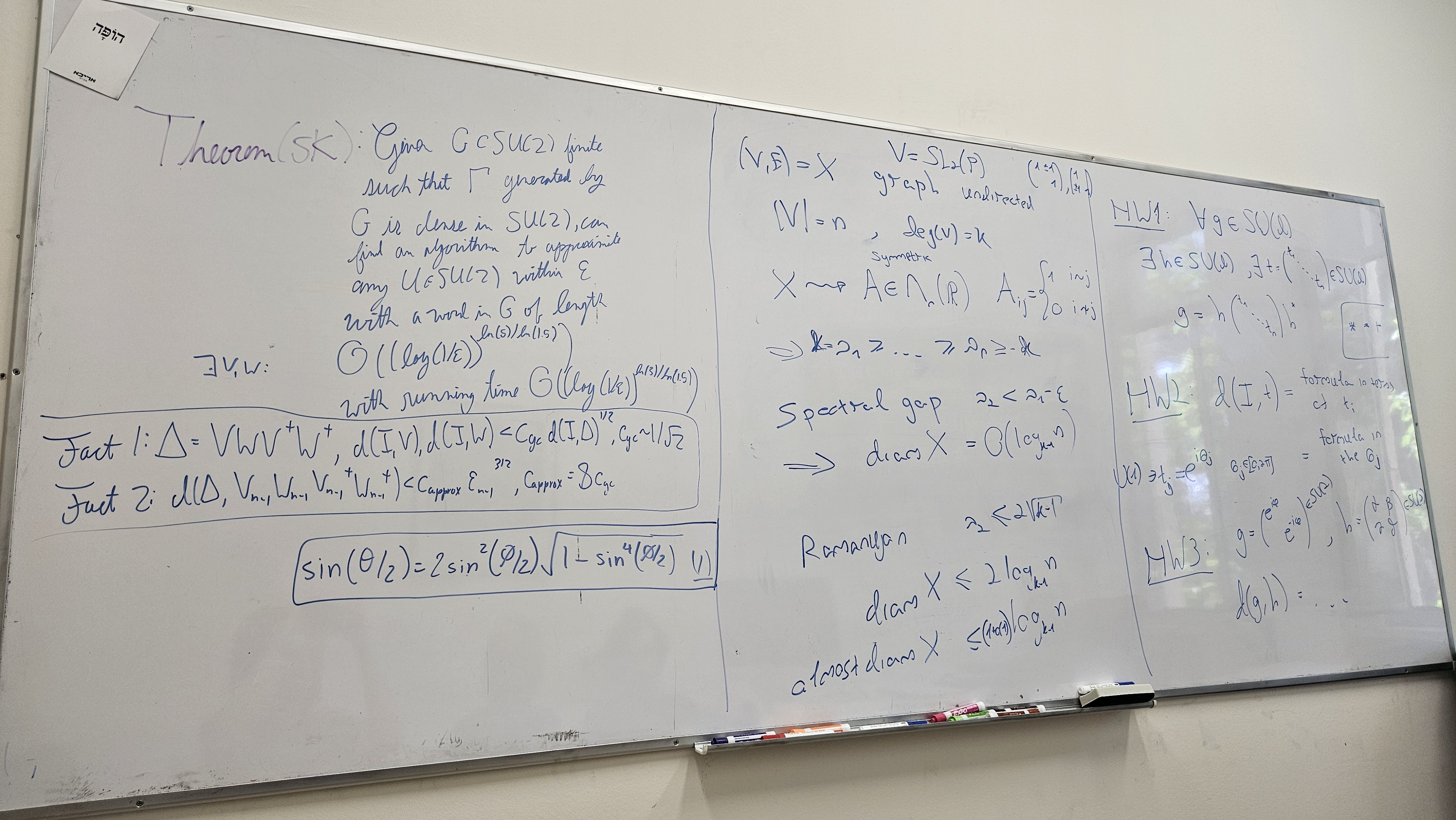
I was able to meet with my advisor, Professor Shai Evra, and the project was broadly introduced to us. From what I currently understand, a large fragment of the REU is dedicated to understanding the Solovay-Kitaev theorem for compact Lie groups, and potentially attempting to extend the algorithm to general groups. Depending on the direction, we might also attempt to work on an open problem in group theory, or possibly go in some other directions relating to quantum algorithms and algebraic number theory. I imagine objectives and interests will shift, but this is the basic skeleton of the program.
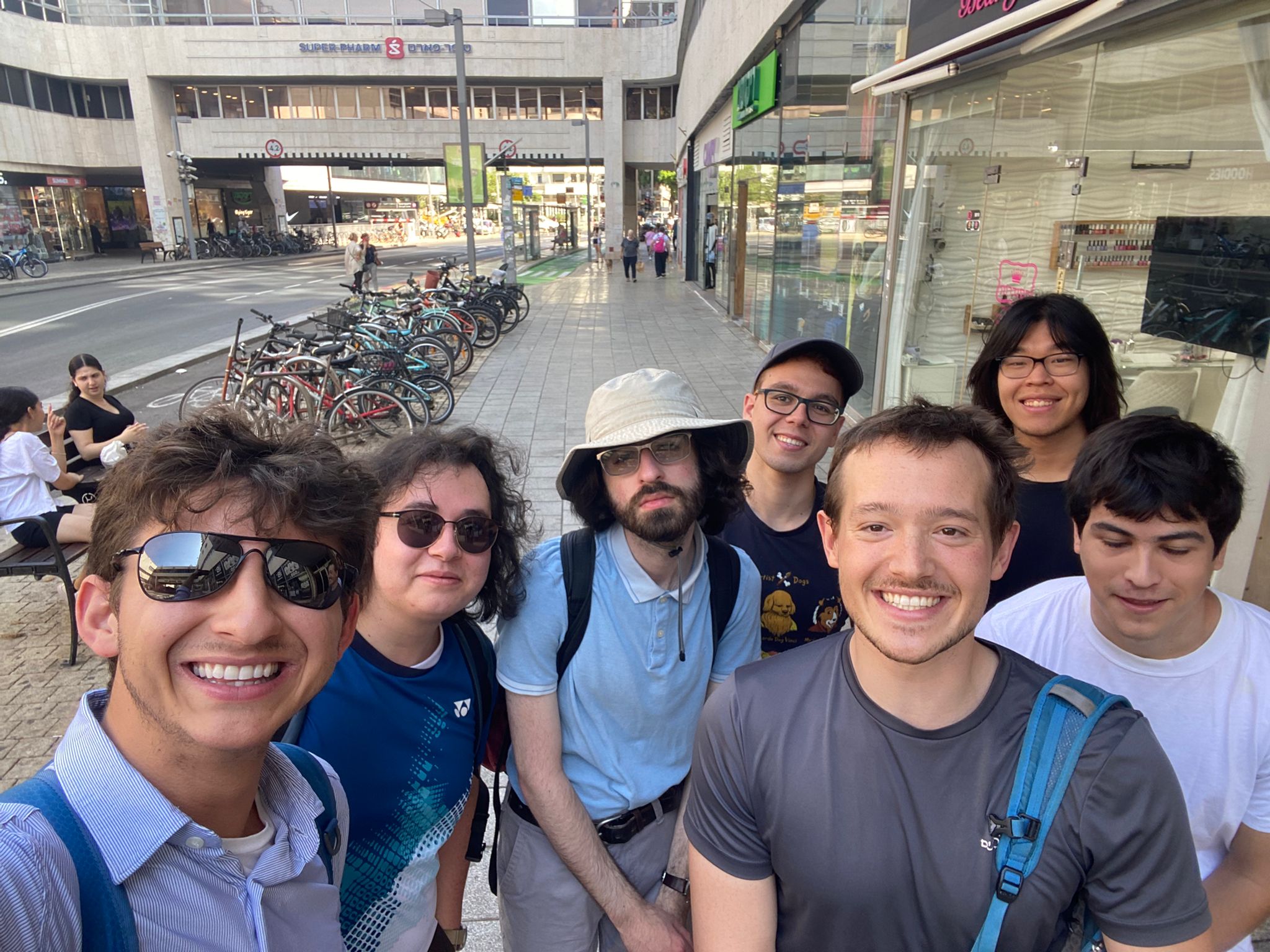
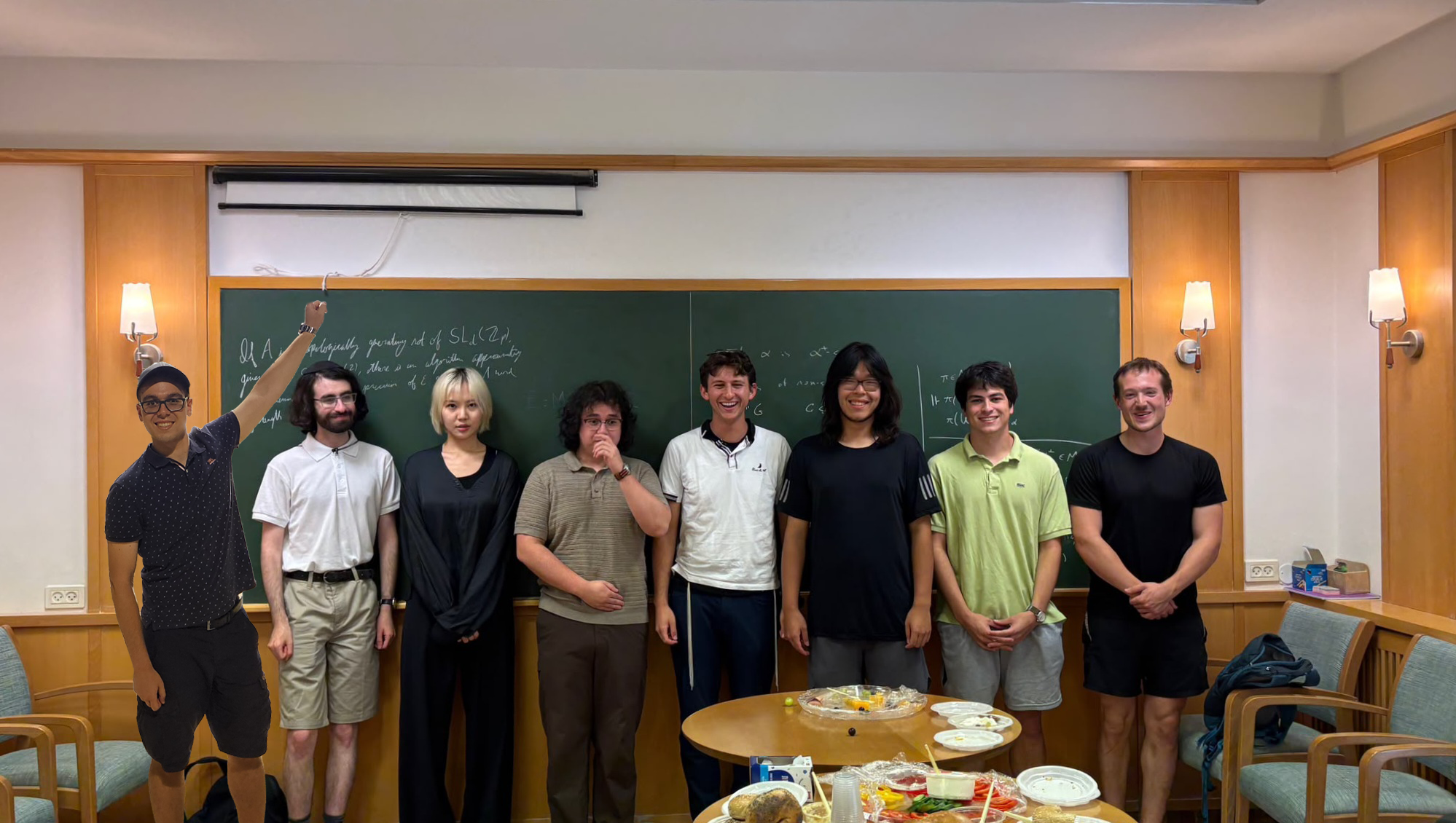
I've also had a lot of fun meeting the other people in the program, and it's nice to see how international our group is! We have people from China, South Korea, Greece, and the United States.
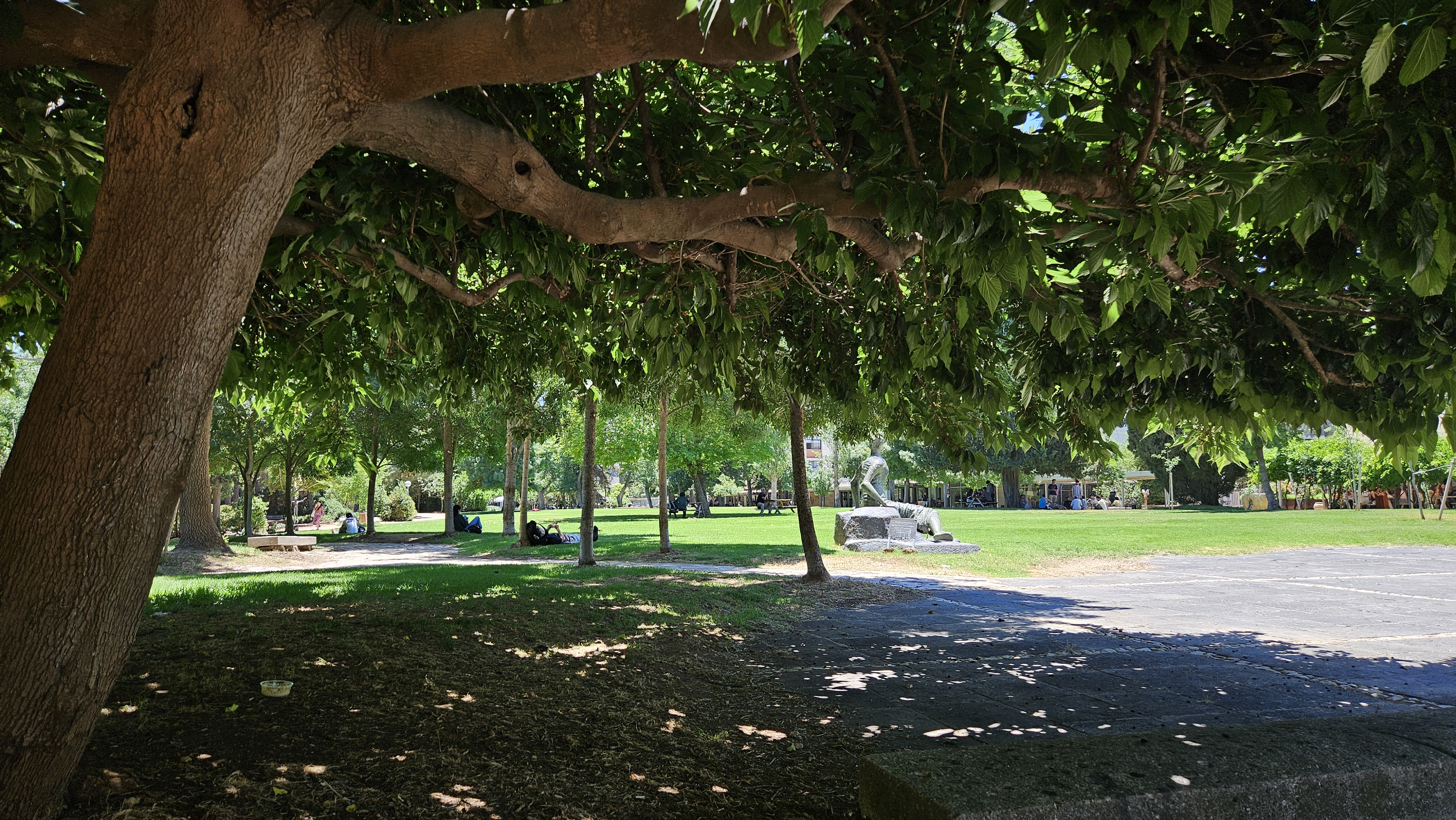
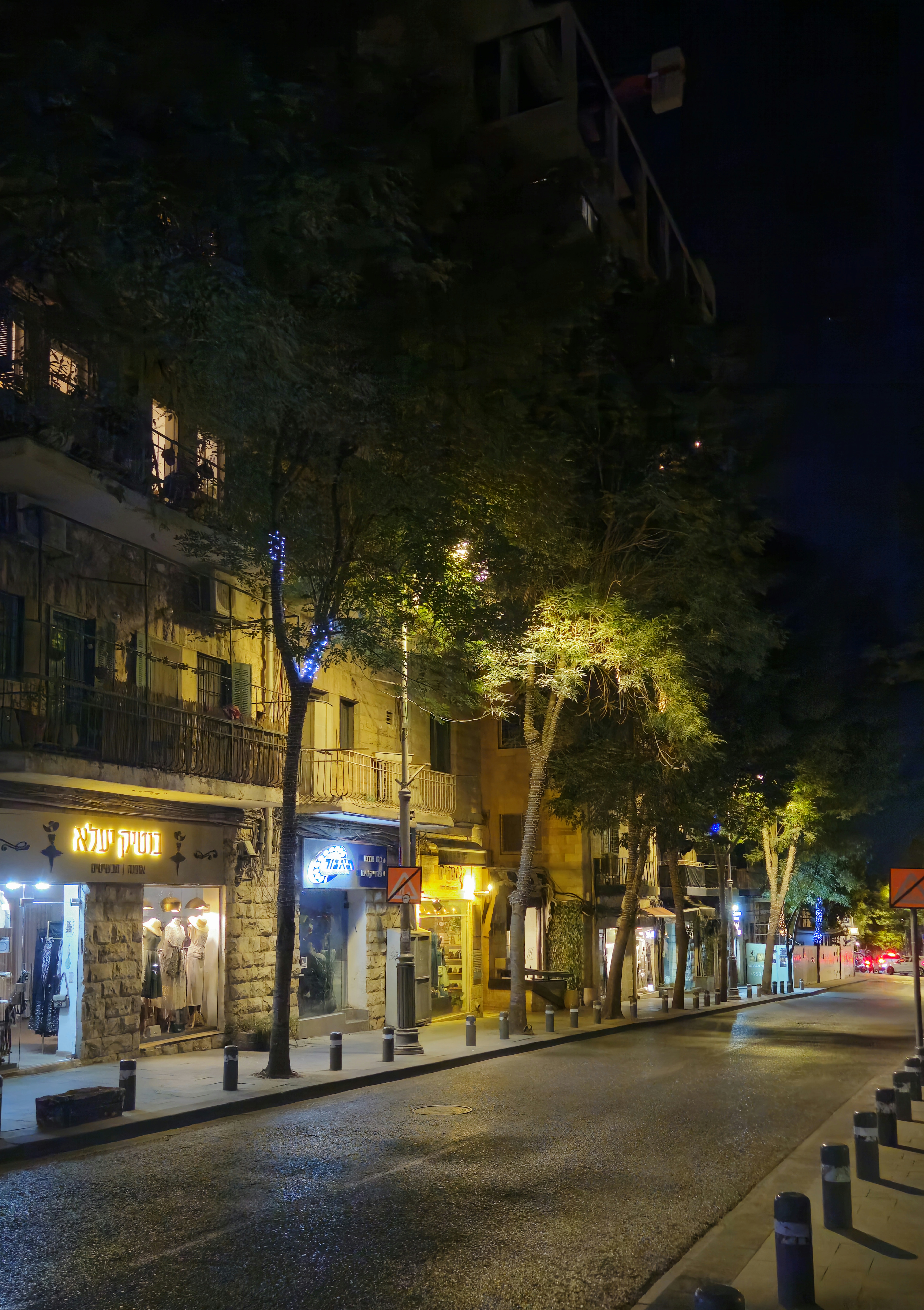
Anyway, some of us visited the campus today, and I have to say: the Hebrew University has a rather nice campus, and I really appreciate the combination of traditional and brutalist architecture. Here are some random pictures.
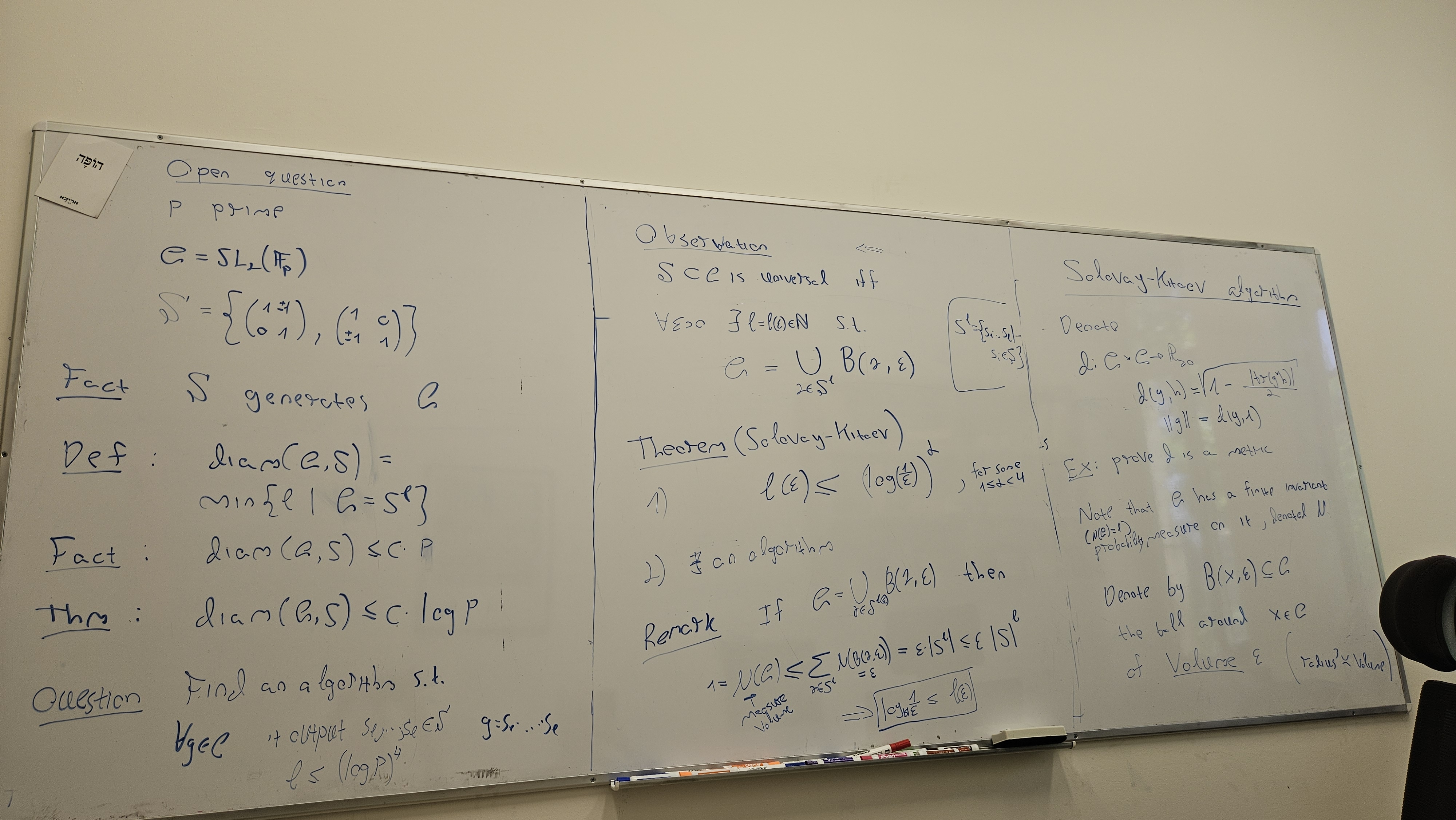
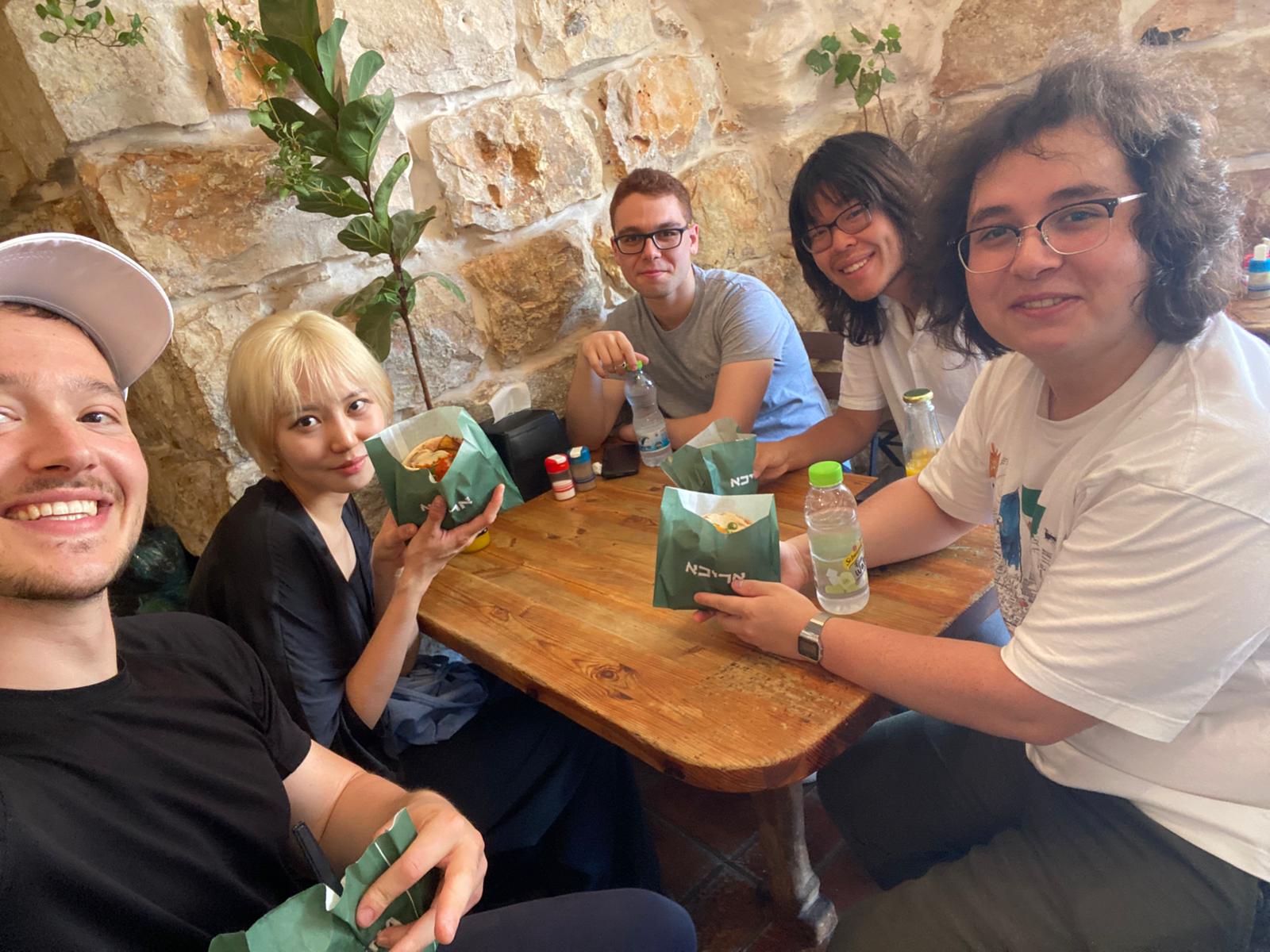
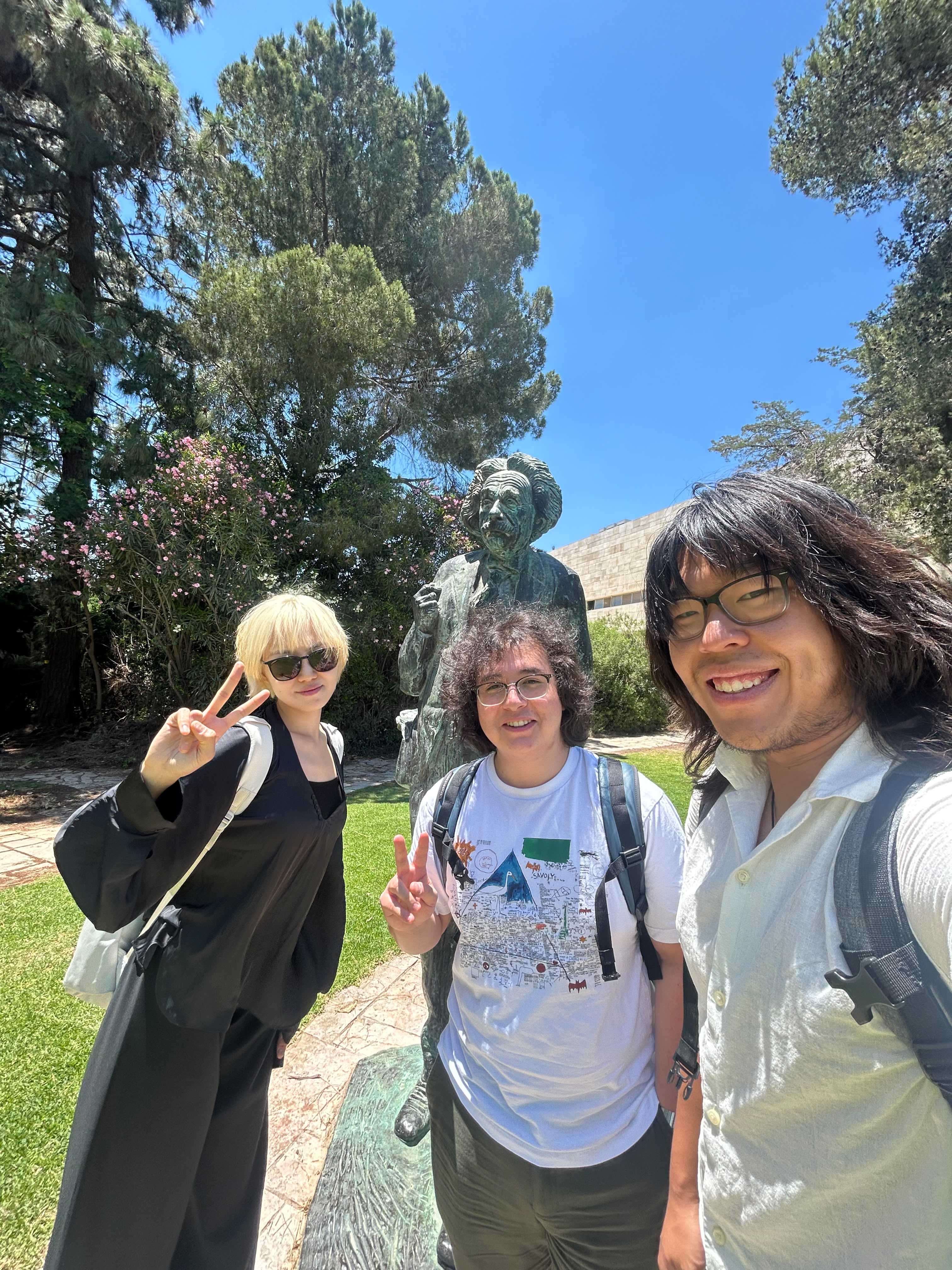
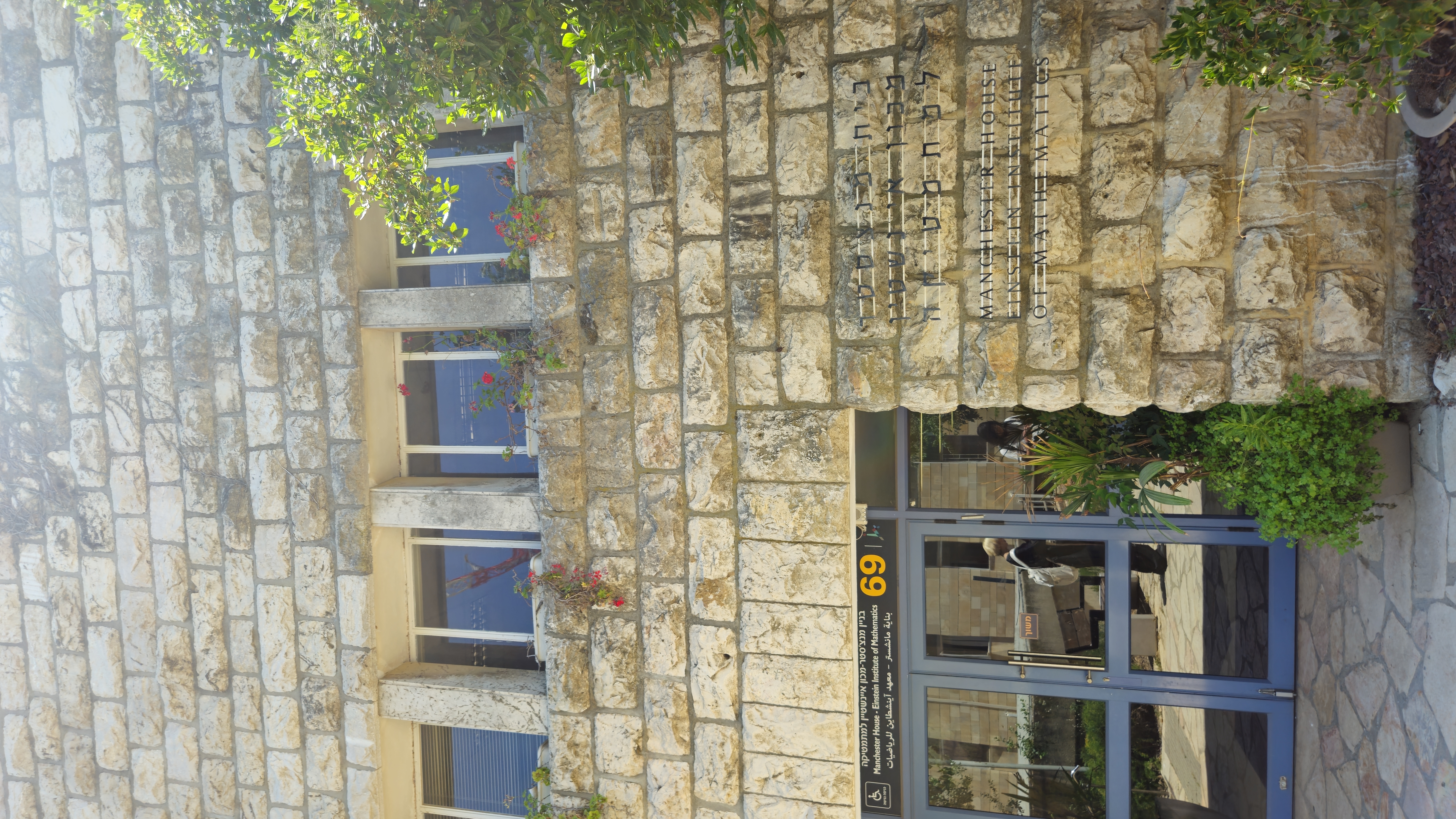
(11 June, 2026)
I suppose now that I have been here for a few more days, I should talk a bit more about the project. I mentioned before that the aim of the REU was to generalize the Solovay-Kitaev theorem to more general groups. The SK Theorem was particularly revolutionary for quantum computing as it established a method for approximating any quantum gate to a very high accuracy and in polylogarithmic time and length.
A paper from Dawson and Nielsen established the main results and provided an algorithmic proof, introducing, loosely, the concept of a balanced group commutator for \(\textrm{SU}(2)\) and \(\textrm{SU}(d)\). It turns out that the existence of the balanced group commutator is a useful tool that comes from compact Lie groups, notably in the inverse mapping from the Lie group to the Lie algebra of \(\textrm{SU}(d)\). Dawson and Nielsen mention an error that is exactly the balanced group commutator, and I learned that it is possible to derive from the BCH formula.
To think in the minds of people attempting to expand the field of quantum computation, it would seem reasonable to attempt to extend the SK Theorem beyond just compact Lie groups, or perhaps to theoretically suggest an algorithm with a shorter quantum gate sequence and shorter computational time. My mentor suggested a 2002 paper that covered this, and the SK Theorem was improved slightly for specific non-general groups.
I am still in the early stages of learning the tools, but it turns out that a conceptual approach to generalizing the SK Theorem (but first and foremost, something more theoretical at the intersection of representation theory, Lie theory, and analysis that I cannot grasp quite yet) involves something known as an expander graph, particularly a Cayley graph. While I am still sorting out the details of expander graphs, I understand them currently as a graph that has nice connectivity properties—this means that the diameter of the graph is bounded favorably and possesses a value known as the spectral gap, which measures connectivity—the larger the spectral gap, the more connected a graph is. I've seen \(k\)-regular graphs used largely in this context. Cayley graphs, on the other hand, coming from Cayley's Theorem in group theory, represent group structure in a graph nicely, generating an entire finite group from a generating set; we can denote such graphs as \(\textrm{Cay}(G,S)\) for some group \(G\) and a generating set \(S\). The idea is that the vertices in a Cayley graph represent elements of a quantum gate set, and the edges represent a finite generating set—the choice of this generating set is important, and there are many collections. One that I have seen notably is the Clifford\(+T\) set, containing the \(H\) and \(T\) gates, or the Hadamard and \(\pi/8\) gates respectively. Since Cayley graphs are well connected (this is a non-rigorous way to say it), we might ask how we can formulate a short word from the generating set so as to approximate an arbitrary quantum gate.
Groups in general are discrete objects. This means that there is going to be a feasible word that can be applied to a given quantum gate to reach a target quantum gate. However, in the case of \(\textrm{SU}(2)\), which is also a smooth manifold, such a generating set can be difficult and intensive to obtain. A 2018 survey paper from Lubotzky and Breuillard that I was instructed to read (and still need to read more of) mentions a new operator, known as a Hecke operator or "averaging operator" that is needed for a curved space such as \(\textrm{SU}(2)\). I still have to figure out what exactly this operator is in the context of expander graphs, but I'll treat it (and about 80% of the rest of the paper) as a black box for now. One tool, mentioned also in Lubotzky and Breuillard's survey paper, is the idea of golden gates. Golden gates were introduced by Ross and Selinger in a 2014 paper, and, as the name suggests, they are the "golden" approach for generating a group like \(\textrm{SU}(2)\). I still need to read the paper, but surprisingly, there is a decent amount of algebraic number theory at play and I'm excited to see where that goes. I think my mentor has worked closely with golden gates in his recent research. Lots more to read.
Before anything, I think I should mention that I've never read a math research paper at the frontier of math before. Even these papers are a few years old (though constantly re-referenced and cited), but they contain so many ideas that I could not possibly fit into 2 years of undergraduate study, much less 2 months of an REU. I guess I had an idea that math research should be cumulative, as in I should understand all of the vast literature before and have learned every single idea and term mentioned. I think reading through some of these papers, I've learned that I do not understand a million things. And I felt uncomfortable. So many rabbit holes to go down on Wikipedia... and then I see another textbook that I should download. I think ultimately, the main takeaway that I should apply to my work in this REU and future research is the importance of the black box: it shouldn't be used for everything, but "[n]o new research would ever get done if the researcher tried to intimately understand the entire path from Pythagoras to the state of the art." I'm an undergraduate, after all.
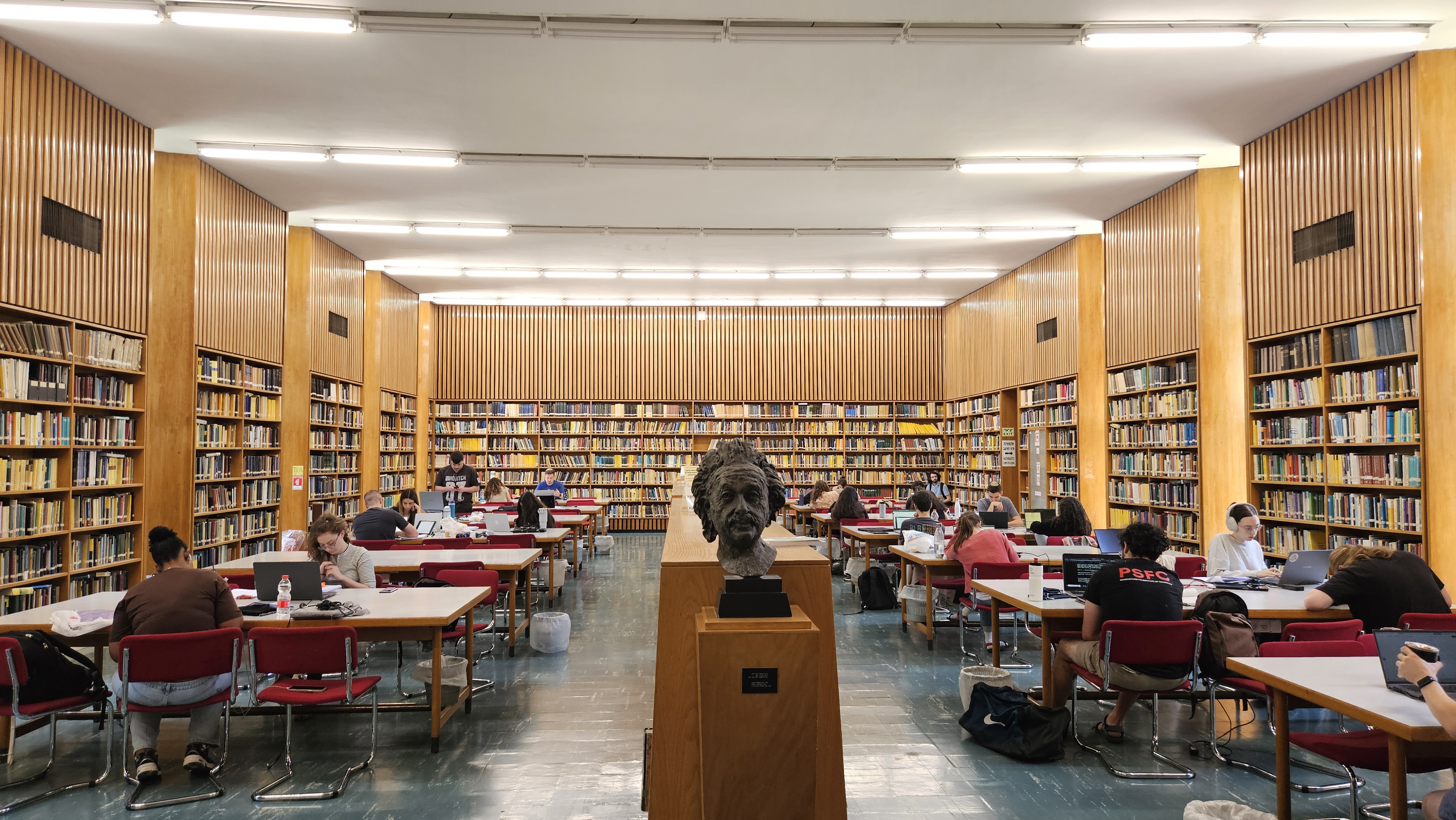
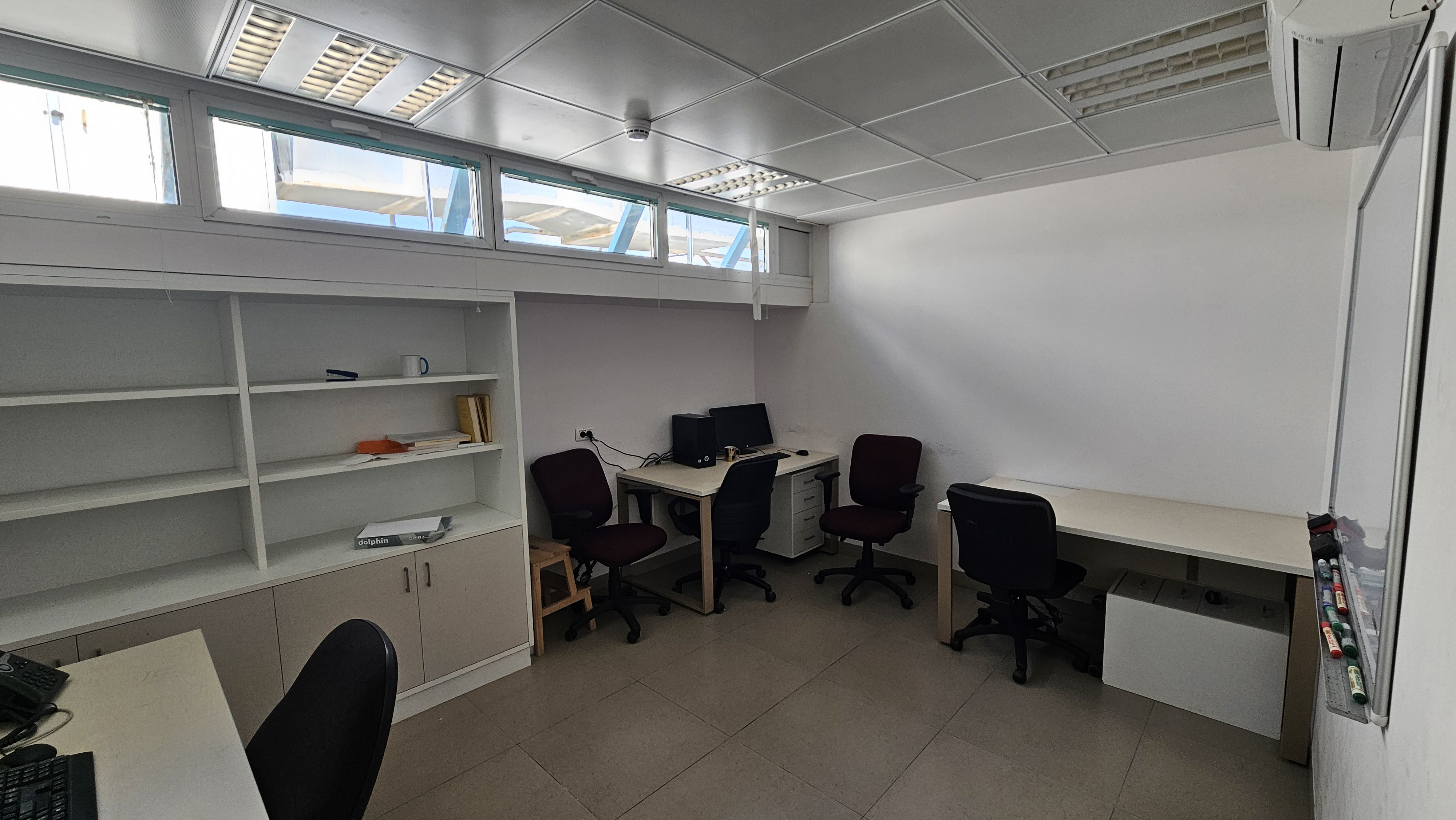
In these few days, I've returned to campus one more time. The REU acquired a computer lab room for work in the future, though it does not have a chalkboard/whiteboard (the temperature may also be controlled and set to frighteningly low temperatures, much to one person's dismay). Above is a picture of the mathematics library—lots and lots of textbooks. If this collection were aggregated and sold online, I can only imagine how valuable it would be—potentially millions, considering 90% of the books appeared to be Springer.
As part of REUs, I think there is a tradition of bringing students to conferences taking place locally. My mentor suggested we attend the Midrasha Mathematicae on Groups, Expanders, and Codes next week, a conference at the Einstein Institute for researchers in the field of quantum computation and the exact area that my REU project is on (without surprise, my mentor is one of the organizers). I expect to understand less than 1% of the material from the talks, but I hope to be able to appreciate the atmosphere and get a taste of what a conference should feel like. Maybe I can ask some good questions if I read more diligently this week!
(14 June, 2026)
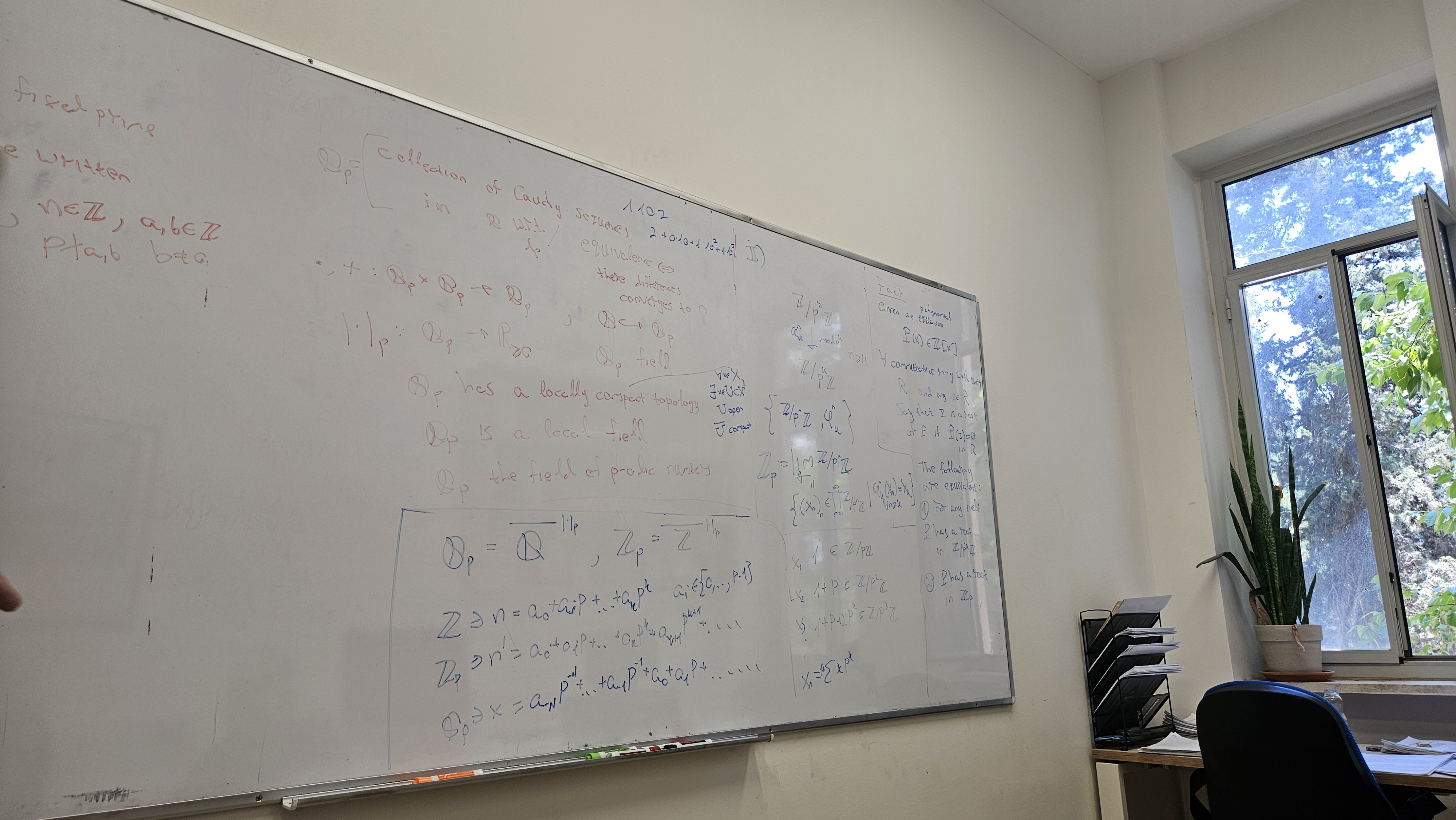
I don't expect to update this page as frequently after this as fewer new things will be happening. I attended the first day of the conference, and I must say that doing so was illuminating rather than useful. While I have listened to some small seminars or lectures before, I've never attended a conference that contains a large number of such lectures that contain incredibly dense and cutting-edge mathematics. I went into the conference expecting to understand a very small amount, and even I was surprised. After surveying Breuillard and Lubtozky's paper for some time, I believe I developed a conceptual intution for what was going on, i.e. that the talks (primarily the talks given by Breuillard) were concerned with expander graphs, and that an ultimate goal was to develop notions of expansion and questions of spectral gap in the context of finite simple groups. Most of the details flew over my head, but I enjoyed listening to how various speakers spoke about this research area, and I especially appreciated how I was able to understand some fundamental terms like Zariski-dense, irreducible representation, and more. Below are some photos from the conference.
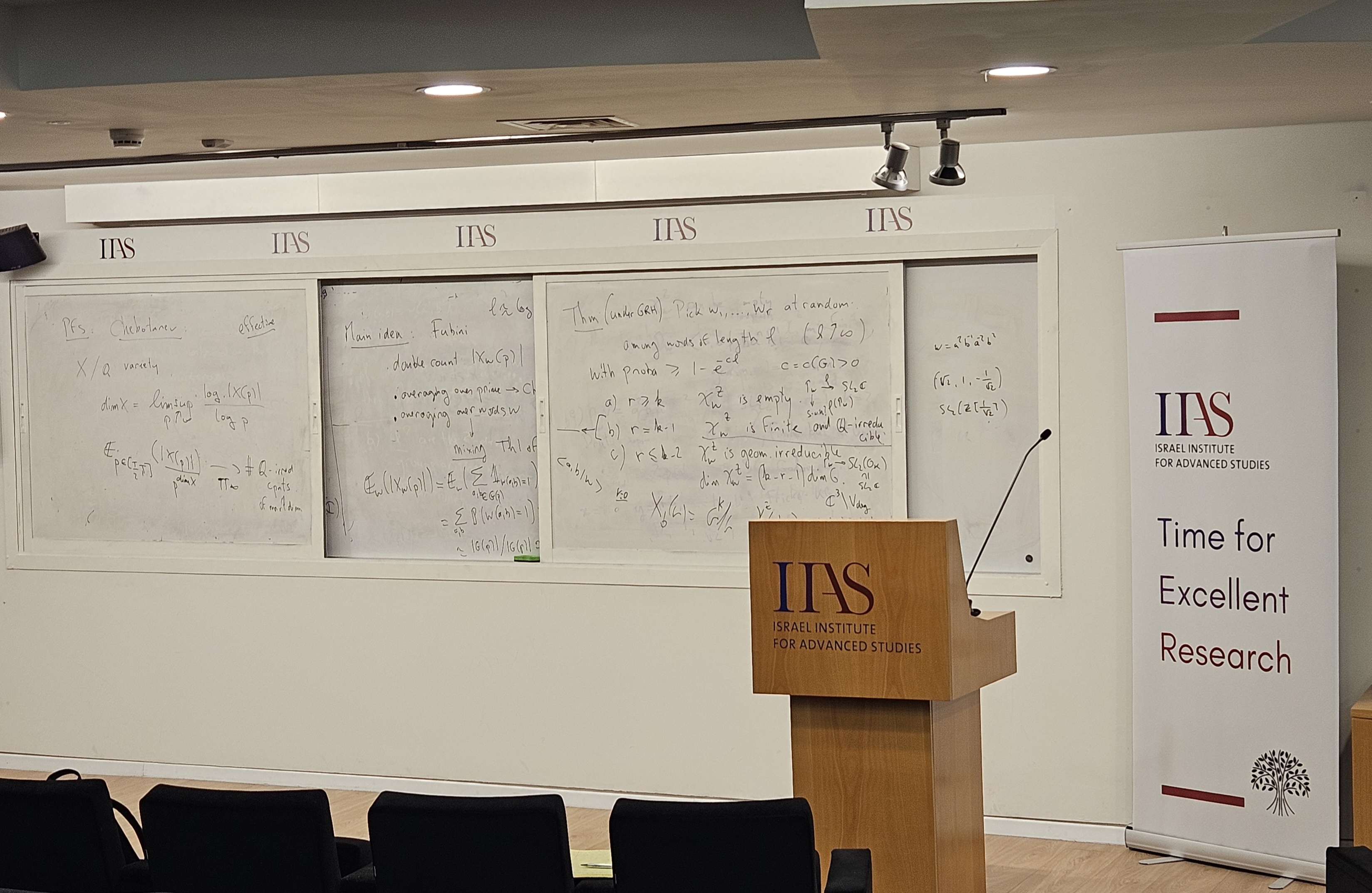
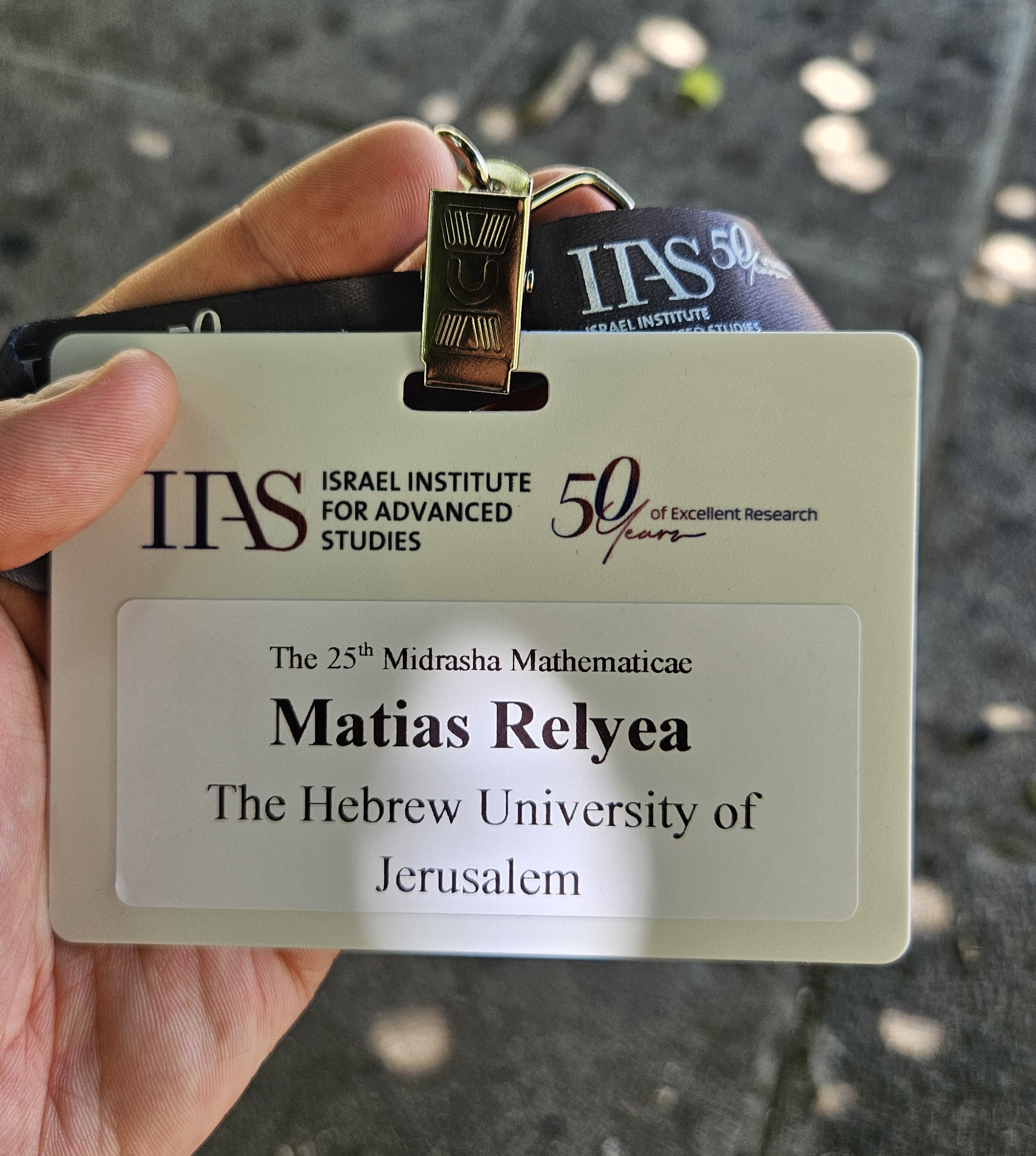
Something that I keep thinking back about is that in research mathematics, people tend to use words like "usually," "almost all," "some," "effective," "sometimes," etc. in reference to results or methods, which just seems so crude from the lack of a better description. I thought mathematics was an indestructible pillar founded on hundreds of year of mathematical formalism—and it is—but it is its crudeness that makes it interesting. I would never have thought mathematics could be similar to applied sciences. But it is. Somehow, trying out different methods and trying to get better and better bounds or isolating particular sets to work in a certain way is akin to watching bacteria multiply or carrying out PCR.
I think this conference was sort of eye-opening for me in a few ways. It excites me that there is so much math on the frontier, but it's a little intimidating. But it was somehow ... relatable that some lecturers said "I don't know" when asked some particularly good questions. There was some shared humor that I didn't understand, but some things were also a bit down to earth, like when the person sitting beside me asked "what are the applications of these results?" I think these aspects of the conference will be among my greatest takeways, mostly because it showcases how mathematics is less of an all-absorbing gel full of pretensious people, and more of a collaborative construction—everyone is putting in their own effort, and developing a vast literature isn't done alone. I hope there is no place for elitism. Perhaps an open question: is it rude to ask something like "how much should I understand?" at a conference like this?
(26 June, 2026)
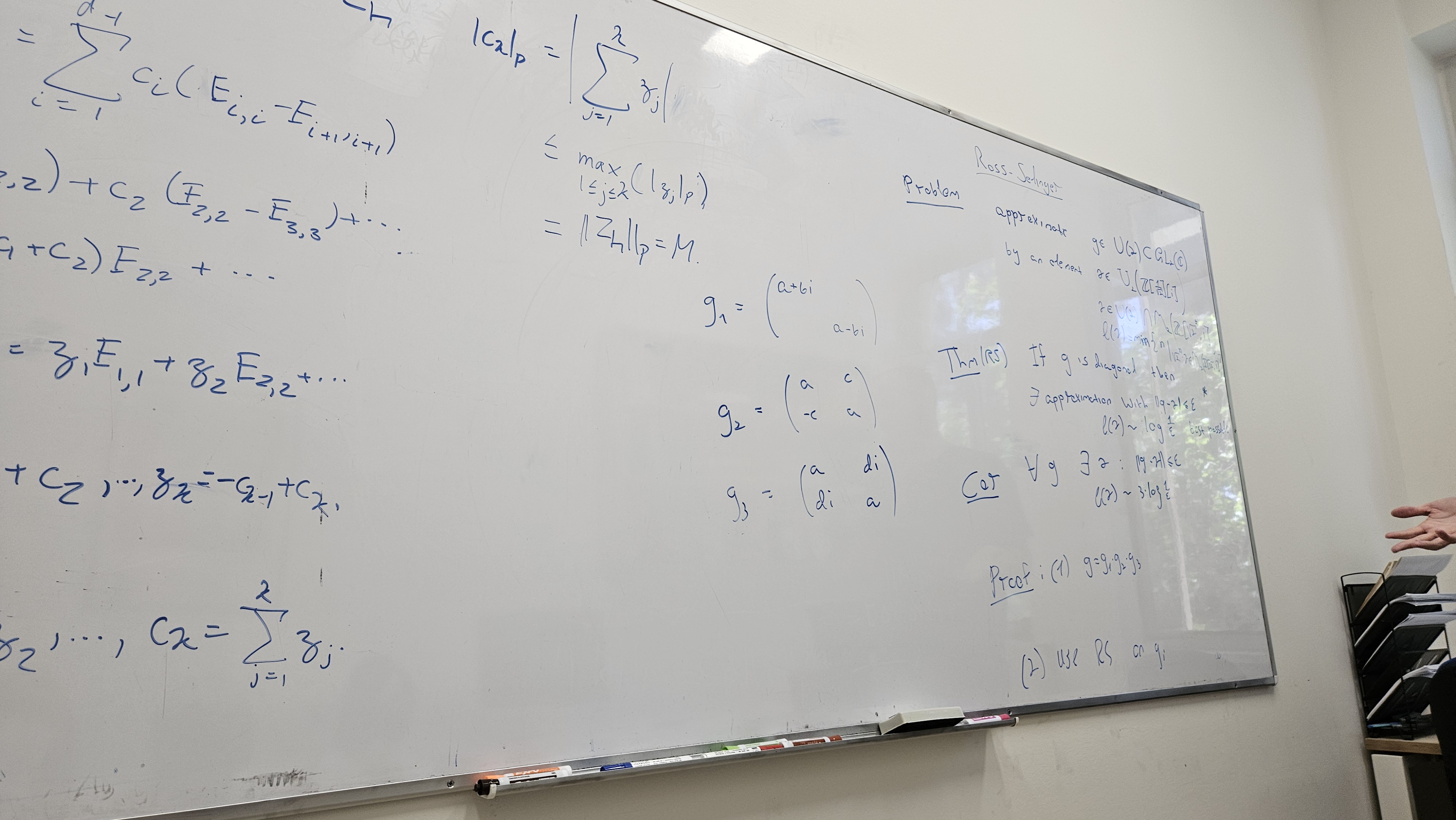
About 2 weeks later, we've worked some more on the project. I skimmed some more papers and we've worked on generalizing a result of Dawson-Nielsen to some avail (sort of pictured below), but I think more machinery will be needed if we want to address a more general result. I've started looking a lot more at recent results, and I've sort of fallen down a more conceptual rabbit hole trying to figure out what exactly to look at next. From what I understand, there are two approaches to the topic of SK-like algorithms. Harrow-Recht-Chuang proved a fundamental theoretical result about words of length \(\mathcal{O}(\log(1/\epsilon))\), but their result is a bit too advanced and theoretical to be useful—people want an algorithm nowadays. So what to do? Some later results of Breuillard-Green-Tao (2011) seem to address some fundamental problems and make some good progress in the more discrete case from a conjecture by Lubotzky in the 80s. This references the important result by Helfgott (2008). I was looking for more recent papers on this, and there are a few papers about navigating Cayley graphs that are highly useful. For example Bradford (2021), which so far to me looks the most promising for what we're trying to do. More to read.
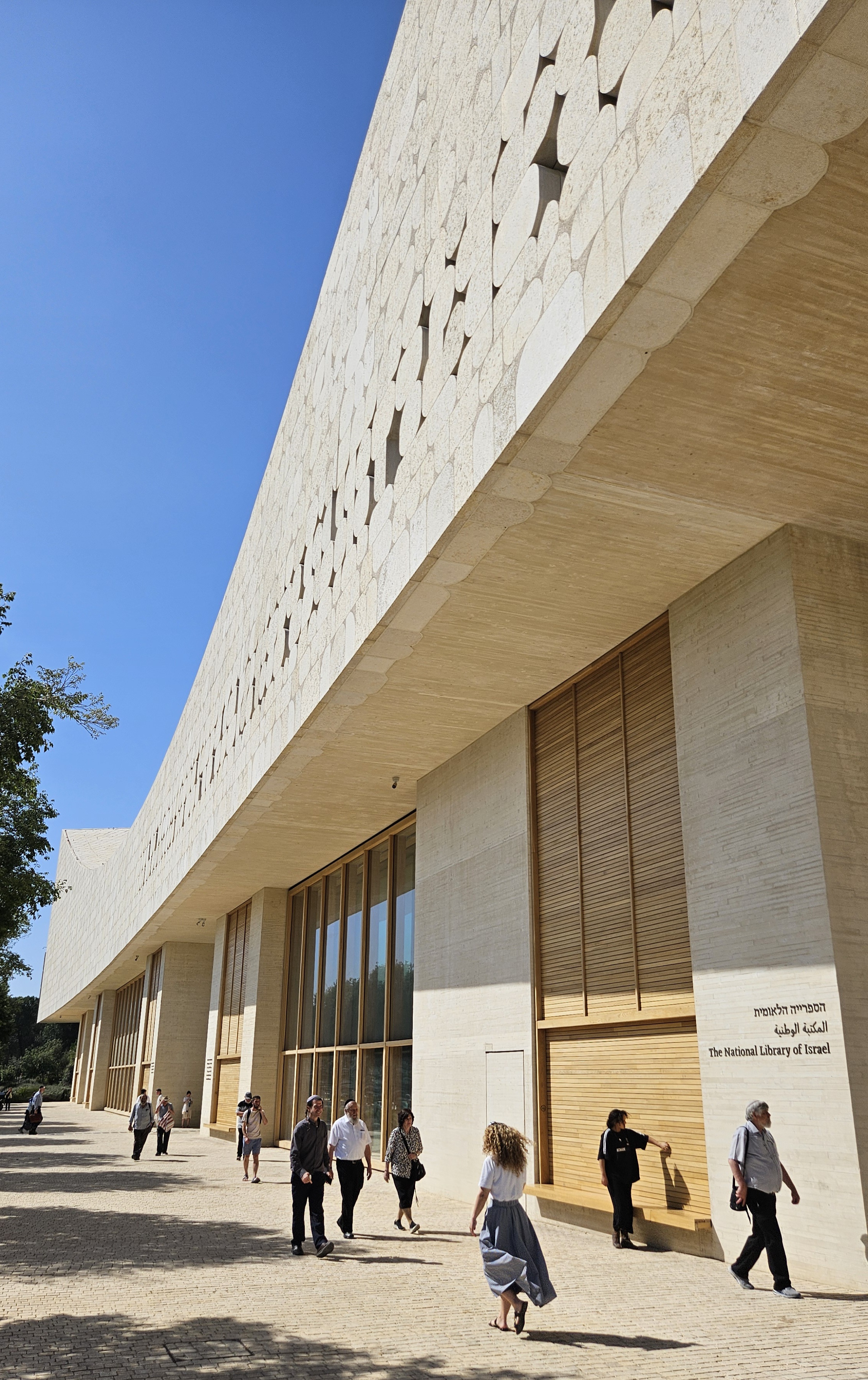
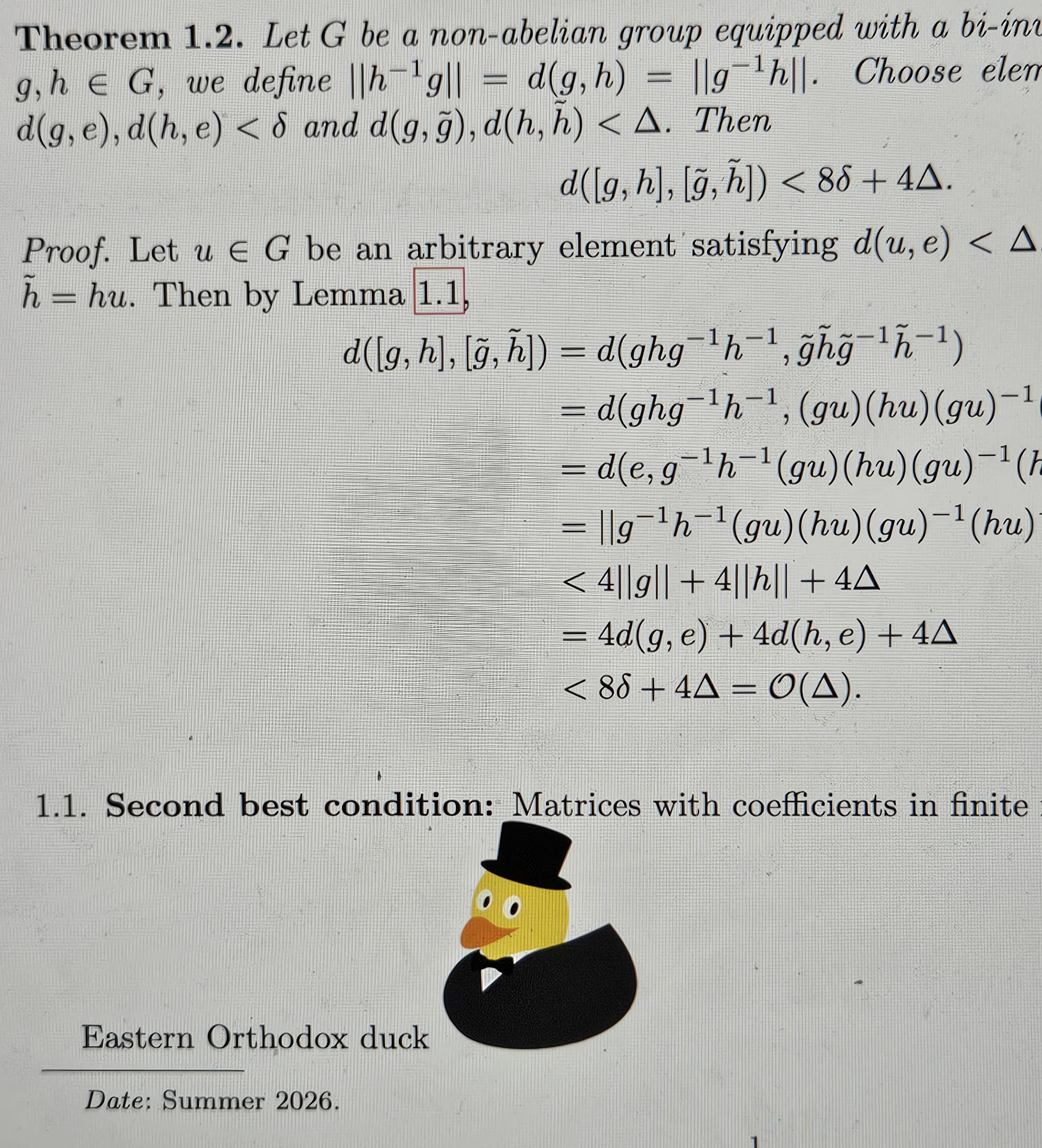
Visited the National Library of Israel. It's a nice library, but I found its exhibition a little underwhelming, maybe because of its lack of things being exhibited. Maybe I'll go back to take a look at some other things. Also, to the right is a duck. I highly recommend ducks, particularly those generated using the tikzducks package.
(28 June, 2026)
(3 July, 2026)
I'm learning quite a few things about research and collaboration. We recently started working on a generalization of the Solovay-Kitaev theorem to \(p\)-adic integers, denoted \(\mathbb{Z}_{p}\). Stated simply, the generalization objective is the following. Let \(G = SL_{2}(\mathbb{Z}_{p})\), where \(p\) is a prime. Let \(\mathcal{S}\subset G\) be some topologically generated set. Then there exists an algebra for all \(\epsilon>0\) and \(g\in G\) such that there exists an \(l = \mathcal{O}(\log(1/\epsilon)^{4})\) and there are finitely many \(s_{1},s_{2},\ldots,s_{l}\in \mathcal{S}\) such that \(g = s_{1}\cdot s_{2} \cdots s_{l}\). With this construction, it is desirable to work with the corresponding Lie algebra \(\mathfrak{sl}_{2}(\mathbb{Z}_{p})\), as we can copy the method used in the classical SK theorem and ping-pong between the compact Lie group and its corresponding Lie algebra using the exponential and logarithmic maps. As such, a lot of the recent work has been to work on generalizations of certain lemmas that make the classical SK theorem work to \(\mathfrak{sl}_{2}(\mathbb{Z}_{p})\), and as I've been working on recently, \(\mathfrak{sl}_{d}(\mathbb{Z}_{p})\) for some \(d>2\).
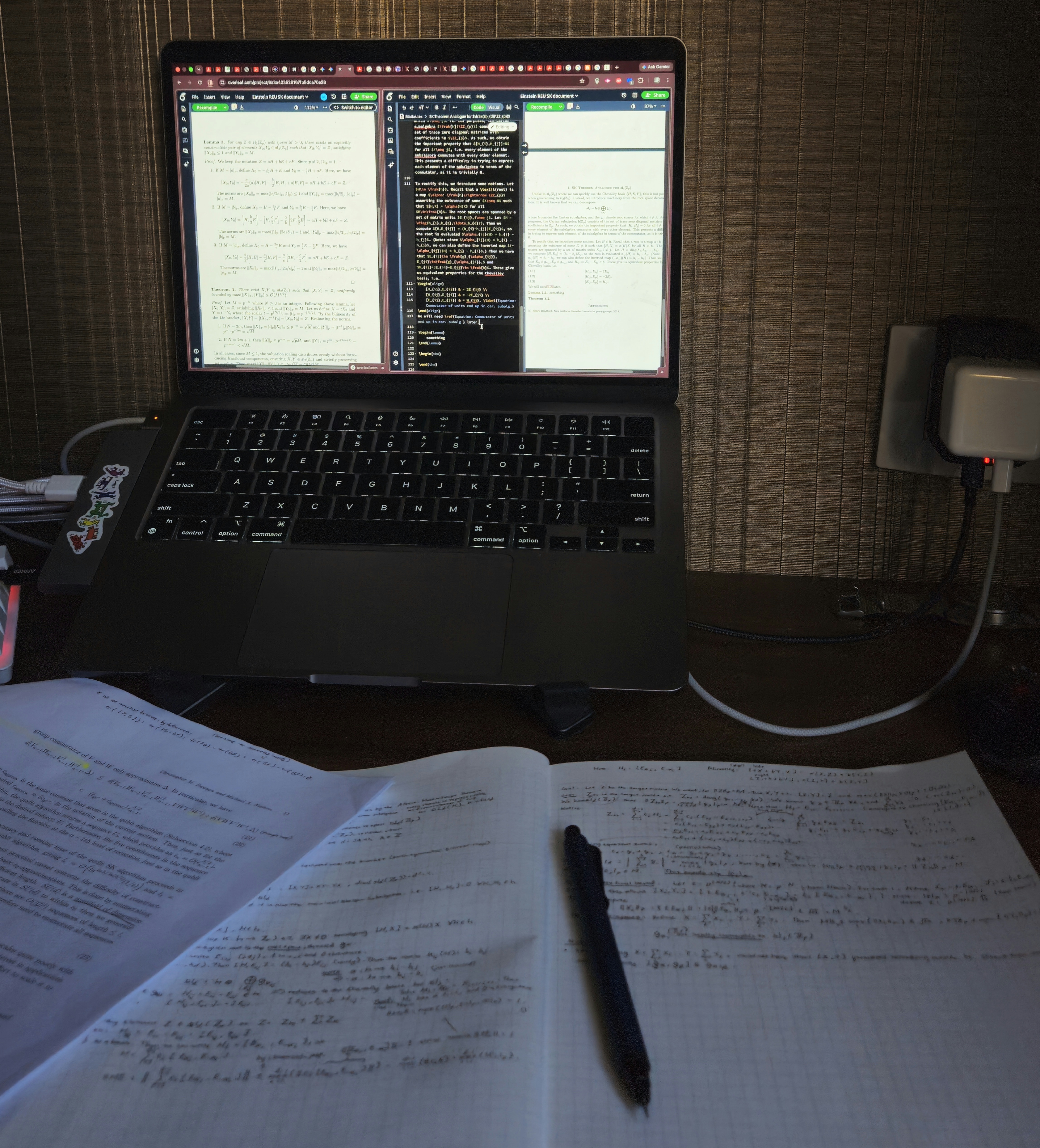
In working on this, I've had to learn quite a bit more Lie algebra theory. We already managed to solve the \(\mathfrak{sl}_{2}(\mathbb{Z}_{p})\) case, but the \(\mathfrak{sl}_{d}(\mathbb{Z}_{p})\) is a better and more interesting generalization. I have yet to come up with an algorithm, but so far I've learned about the root space decomposition (from semisimple Lie algebras), the Cartan subalgebra, and a bunch of other terms specific to my usage here. It turns out there are some nice properties that make the \(\mathfrak{sl}_{2}(\mathbb{Z}_{p})\) case more manageable, namely that we can make use of the Chevalley basis. When working in \(\mathfrak{sl}_{d}(\mathbb{Z}_{p})\), however, we have to consider both root spaces and elements of the Cartan subalgebra. This is what I've worked on so far, but of course there are some other directions to take a look at.
The mathematics aside, I've also learned the importance of good references. Bad references are a headache, hypothetically.
(10 July, 2026)
I'm beginning to get the hang of some aspects of the project, mostly relating to thinking about some problem and digesting new material. It's not uncommon that I will see some terms I haven't seen before, but I believe this is only natural at this point. We allegedly managed to solve the problem in general for \(\mathfrak{sl}_{d}(\mathbb{Z}_{p})\), though I believe there is still significant verification to be done. We were largely considering two different approaches, and some of my contributions partially proved the case in one instance (the Cartan subalgebra) but fell short in root spaces, whereas the other approach could, if treated precisely, be the missing puzzle piece for the problem. This was possible in part due to a completely random 2017 paper by Stasinski covering single commutator representations of elements in \(\mathfrak{sl}_{d}\) defined over any principal ideal ring.
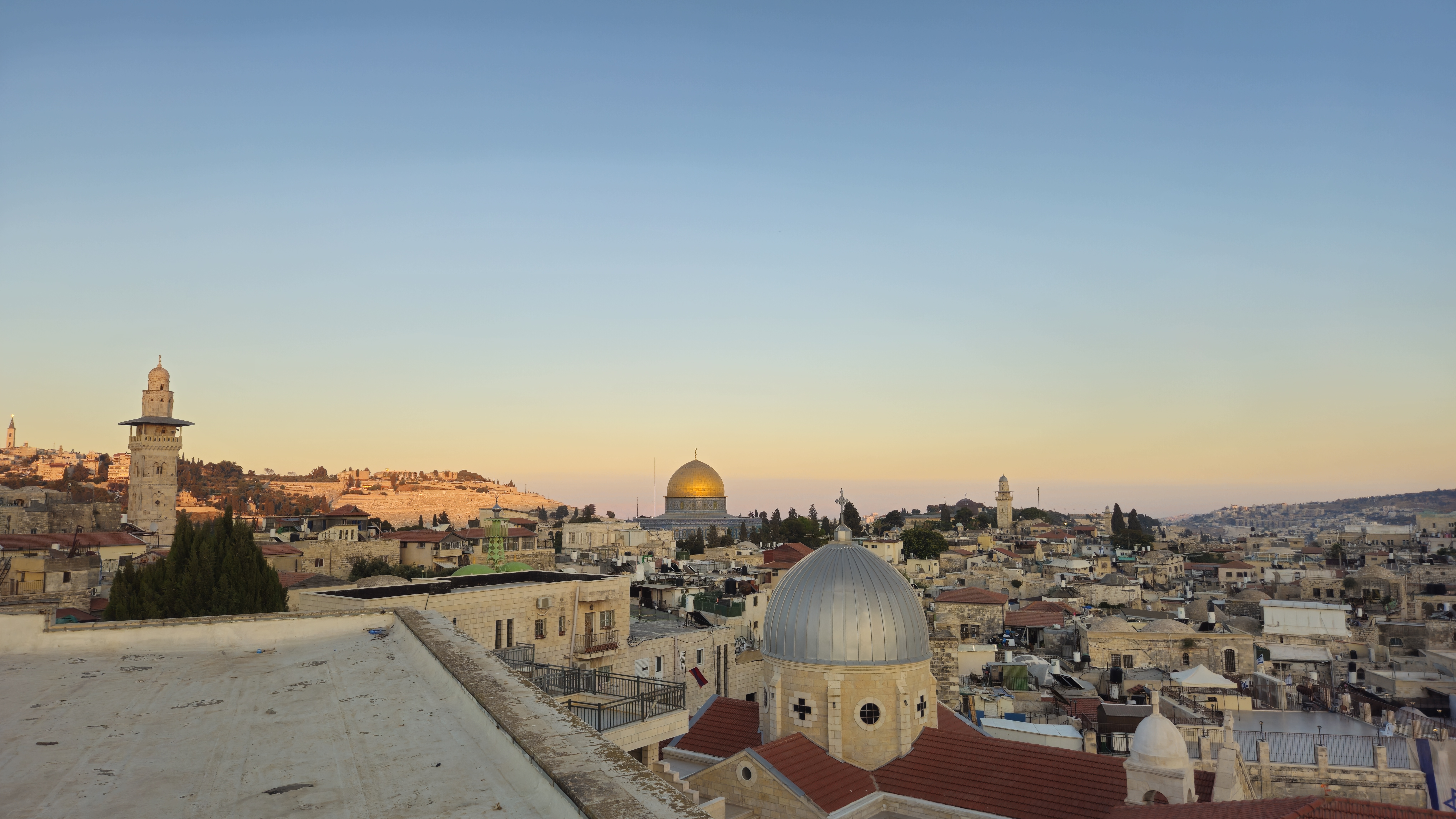
I suppose at this point, it is meaningful to ask some questions about myself. Considering my position, I think it's reasonable to conclude that I won't be coming up with extremely novel ideas regarding local-global principles or anything structural or category-theoretic (which have been suggested). These are complex ideas. So what should I expect to do? I should expect to work hard and come up with small novelties, but I believe I am in no position to create grand results—I think this is a fair position. I've already digested a large amount of new material, and this alone has introduced me to numerous fields and advanced concepts, some even unexpected. For instance, entirely disjoint from the project, I was handed a paper on isogeny-based cryptography, which may or may not be interesting to me. The point is, maybe I shouldn't be too hard on myself. After a 4 hour meeting with our mentor several days ago, I left exhausted, having only understood half of what was presented by part of our own group as progress. I think this is natural, and of my own opinion, I think there is a certain point at which I have to stop asking the question "what's going on?" and instead ask "essentially what's going on?". I find this heuristic far more favorable toward me, as, like I mentioned before, it honors the sacred black box of confusion and not-knowing.
This doesn't mean that striving ambitiously for novel results is incorrect. It simply means that the expectation of novelty and competence shouldn't be erroneously founded.
Whilst on a train at the ungodly hour of 9:30am, a brief discussion arose concerning the usage of AI in research. I've written about this before here, but at that point I did not have a vantage from which to think about the impact of AI on research. A question that I genuinely do not know the answer to stems from here: to what degree should one be qualified to assess the novelty and quality of research produced by AI as legitimate contribution to the literature? I think an obvious answer to this question could be "a professional in a given field," though this misses the point. In some mathematics research, the correct line of questioning and tweaking in an LLM should lead to a legitimate mathematical result, seeing as how advanced models are now (though not discounting future potential). This "correct line of questioning" is a lot more vague than it seems though, since theoretically anyone can ask a good or bad question, either leading to novel or non-novel results. So was the "mathematics research conducted" the line of questioning or was it the contents of the responses and the hypothetically novel results?
Parallel to this, since it is well-established that mathematics generated by an LLM is only significant if understandable, is it disingenuous to minimize our own thinking to reserve time for interpreting LLM outputs—and then claim novelty? I'm really not too sure. Is an overdependence on AI in mathematics research just the beginning?
Anyway, off to read a new 2025 paper on a new approach to the Solovay-Kitaev problem.
(12 July, 2026)
One 2 hour talk later, I acquired some shawarma. This time the topic was a modification of the Solovay-Kitaev algorithm using a new notion known as a higher commutator, introduced by Elkasapy (late) and Thom in a 2013 paper. There's still more to read in the literature here, but I found some notions in Kuperberg's paper, namely that of so-called "zigzag golf," particularly amusing.
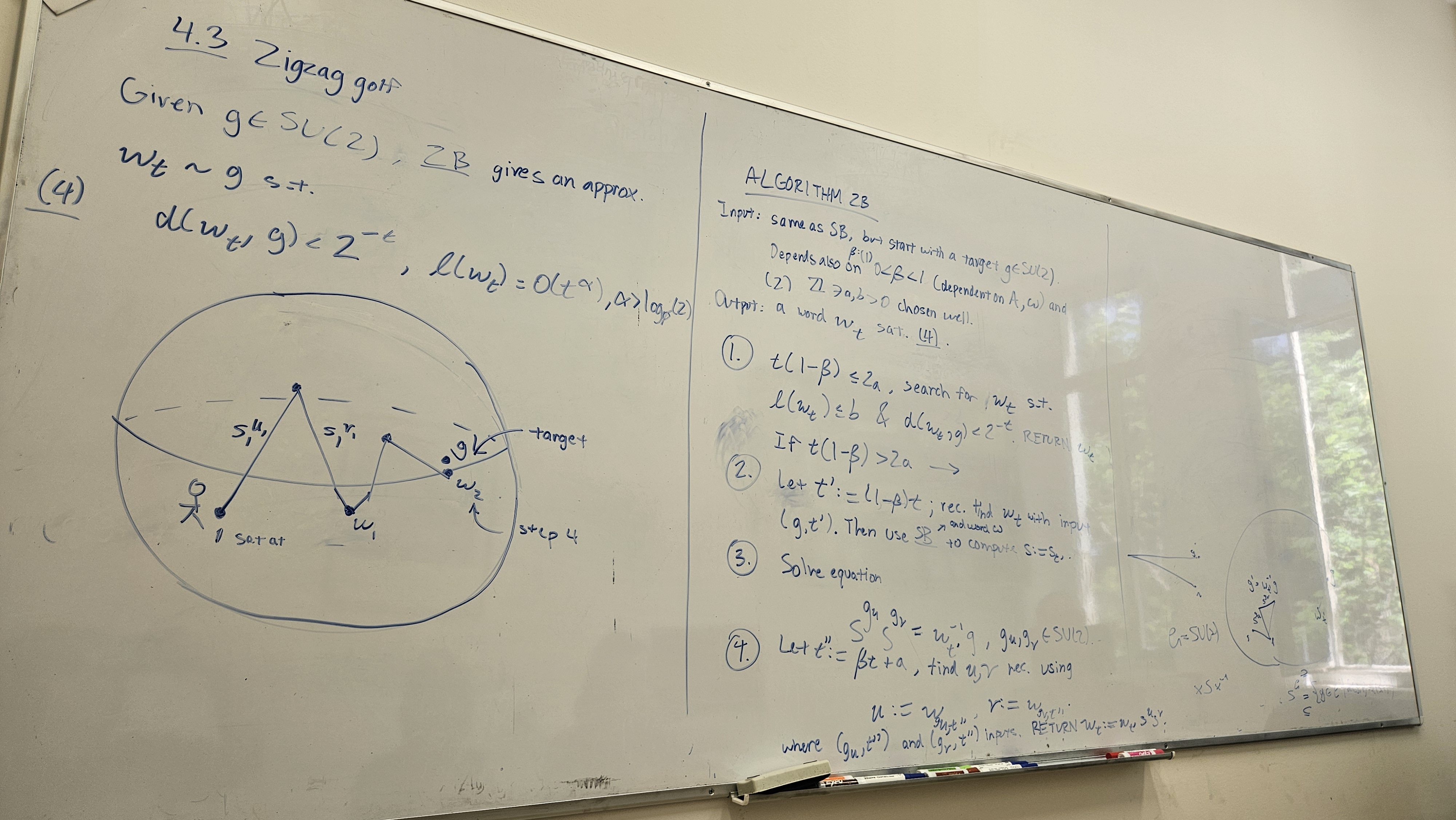
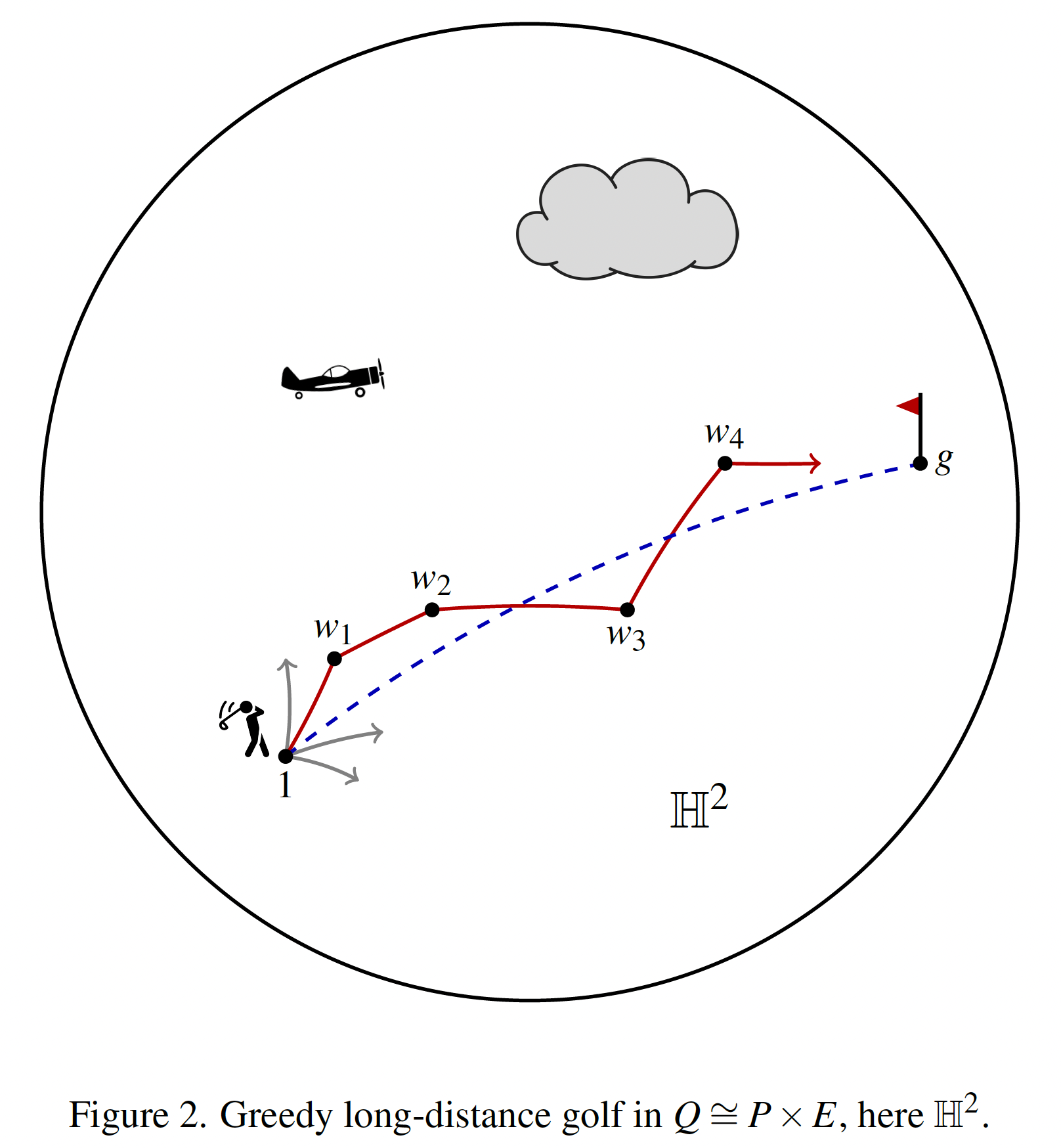
The Solovay-Kitaev algorithm cleverly uses single commutators to recursively approximate an arbitrary quantum gate, but the new Solovay-Kitaev type algorithm introduced by Kuperberg uses higher commutators to swing back and forth in a space (like \(\text{SU}(2)\) or \(\text{SU}(d)\)) to gradually approximate an arbitrary quantum gate. The idea is a little complex and has a few conditions, but the idea of the algorithm is very geometric—something that we will have to generalize to something that isn't just a connected compact matrix Lie group. Much more to think about and try to understand.
My mentor also mentioned a funny notion known as "known by the experts." In simple words, it can describe a collection of results that is probably true, but allegedly no one has had the time to write a paper on it. This, allegedly again, is for the students to fill in—a gap in the literature. I find this idea interesting, and perhaps now, maybe even a bit archaic. With AI research becoming commonplace, is mathematical research dense? How many small things like "known by the experts"—things that sound and behave like tradition—will disappear as the filling-of-gaps becomes a menial task for LLMs instead of a tricky problem for a student? Is tradition like this something we should preserve or is it something we should treat as old-fashioned and a look back at older times?
(15 July, 2026)
I hope some of the entries here, in posterity, both for myself and anyone who bothers to read it, represent how an REU gives a chance to do more stuff than just sit around (or stand around) and think about mathematics all day. In any field, community is vital. People may disagree on many things like philosophy, politics, possibly even the field itself, but the best things about communities like this are the openness of dialogue. Speaking of dialogue, my good friend Orestis has returned home—may he continue winning gold medals not only mathematically but spiritually as well.
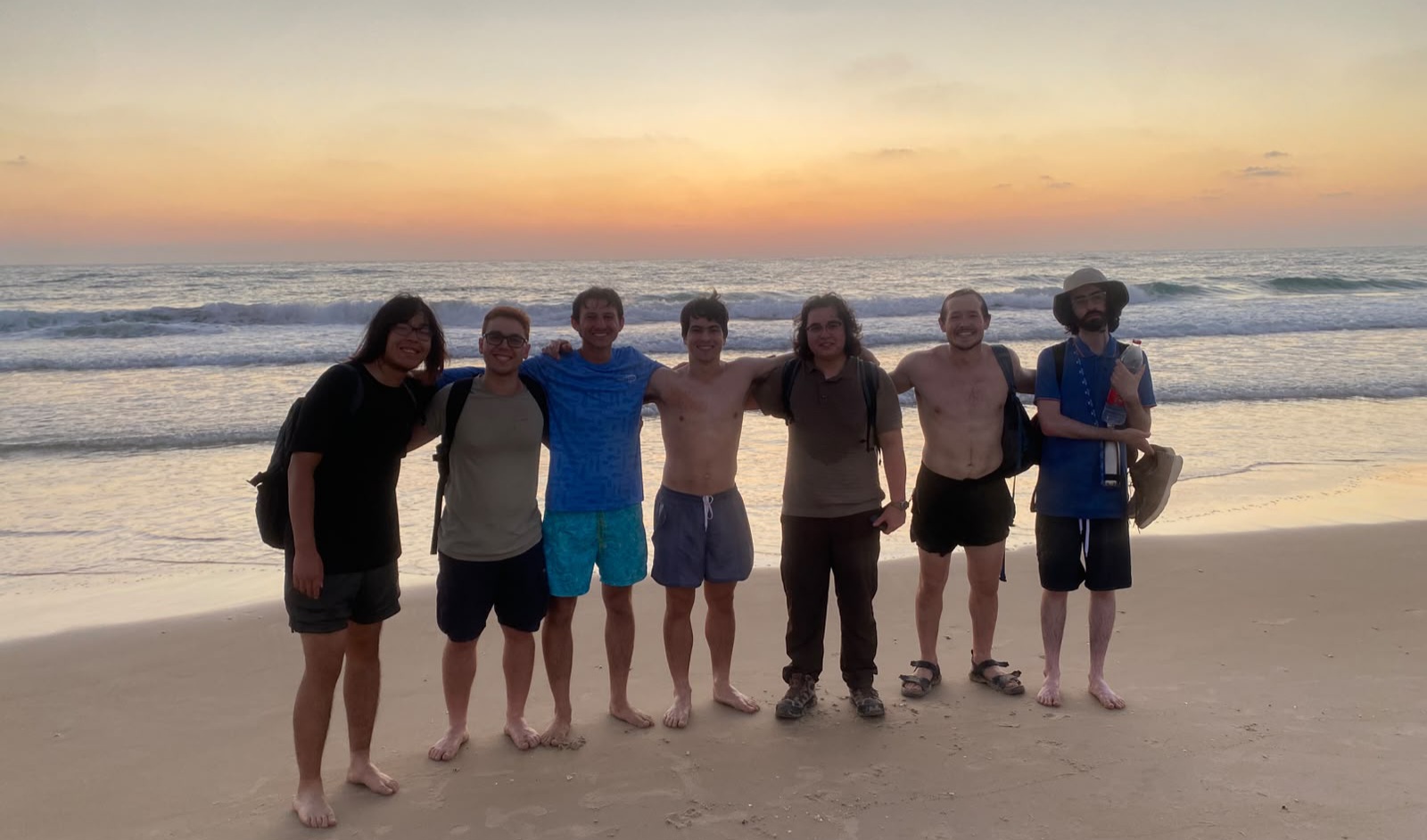
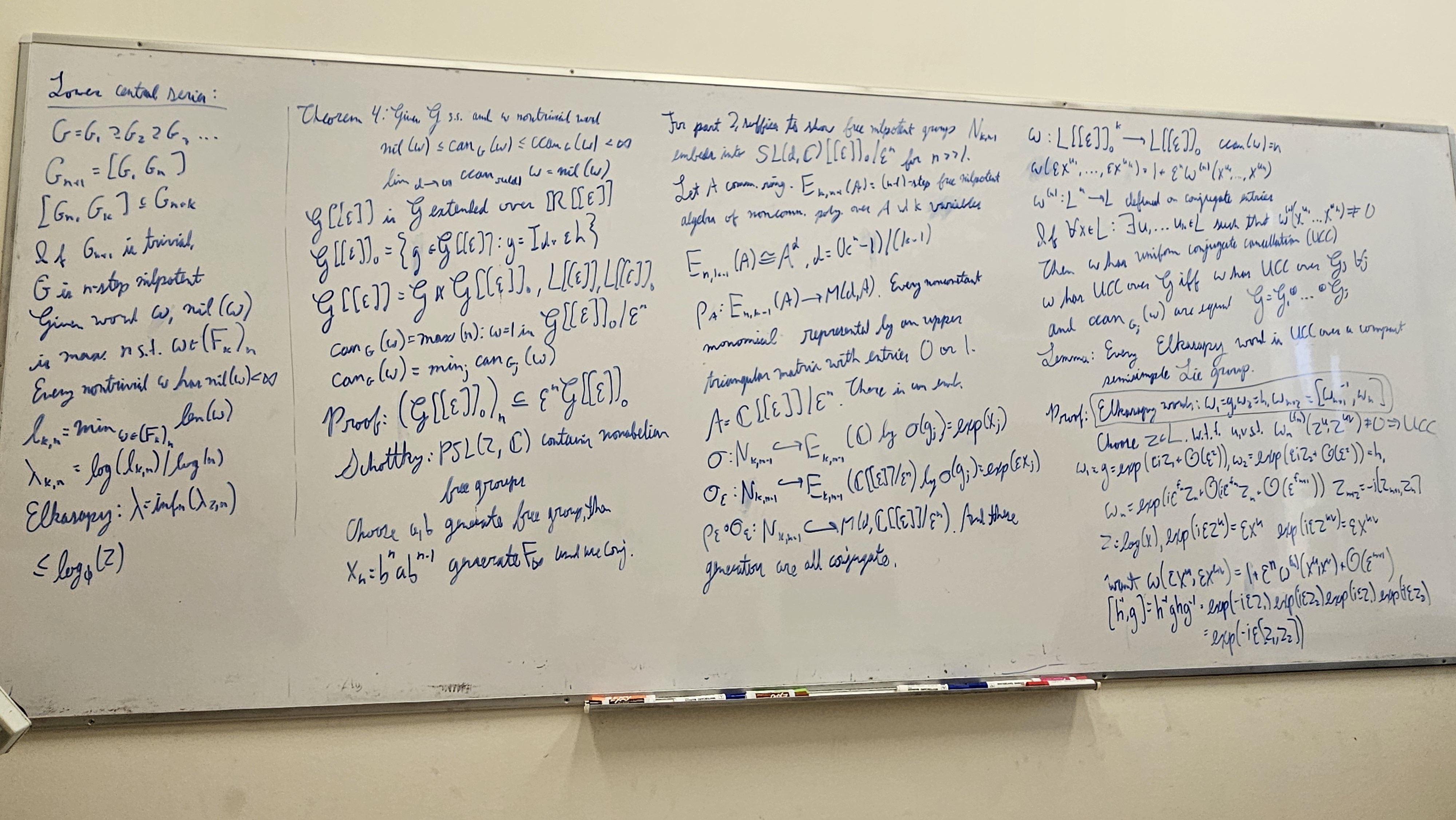
The understanding is becoming increasingly technical. For instance, whose fault is it that I don't know anything about Lipschitz continuity?! Jokes aside, Lie theory is exceptionally beautiful, and I suppose now I'm getting a chance to take a more winding stroll through it. "We are mathematicians, this is what we do."
(20 July, 2026)
As the program nears its end, we have a concrete result to work toward. After listening to hours of presentations about Kuperberg's 2025 paper about using "higher commutators," which are described using Elkasapy words (special words that have a very large conjugate cancellation degree \(\text{ccan}_{SL_{d}(\mathbb{Z}_{p})}(\omega)\), where \(\omega\) denotes the Elkasapy word) we are now at last working toward a \(p\)-adic analogue to the Solovay-Kitaev theorem, which, while receiving treatment from Dinai (2006 paper, Theorem 3.5) when \(\alpha\) is arbitrarily close to 4, has not yet been improved in the literature to consider higher commutators such as Elkasapy words.
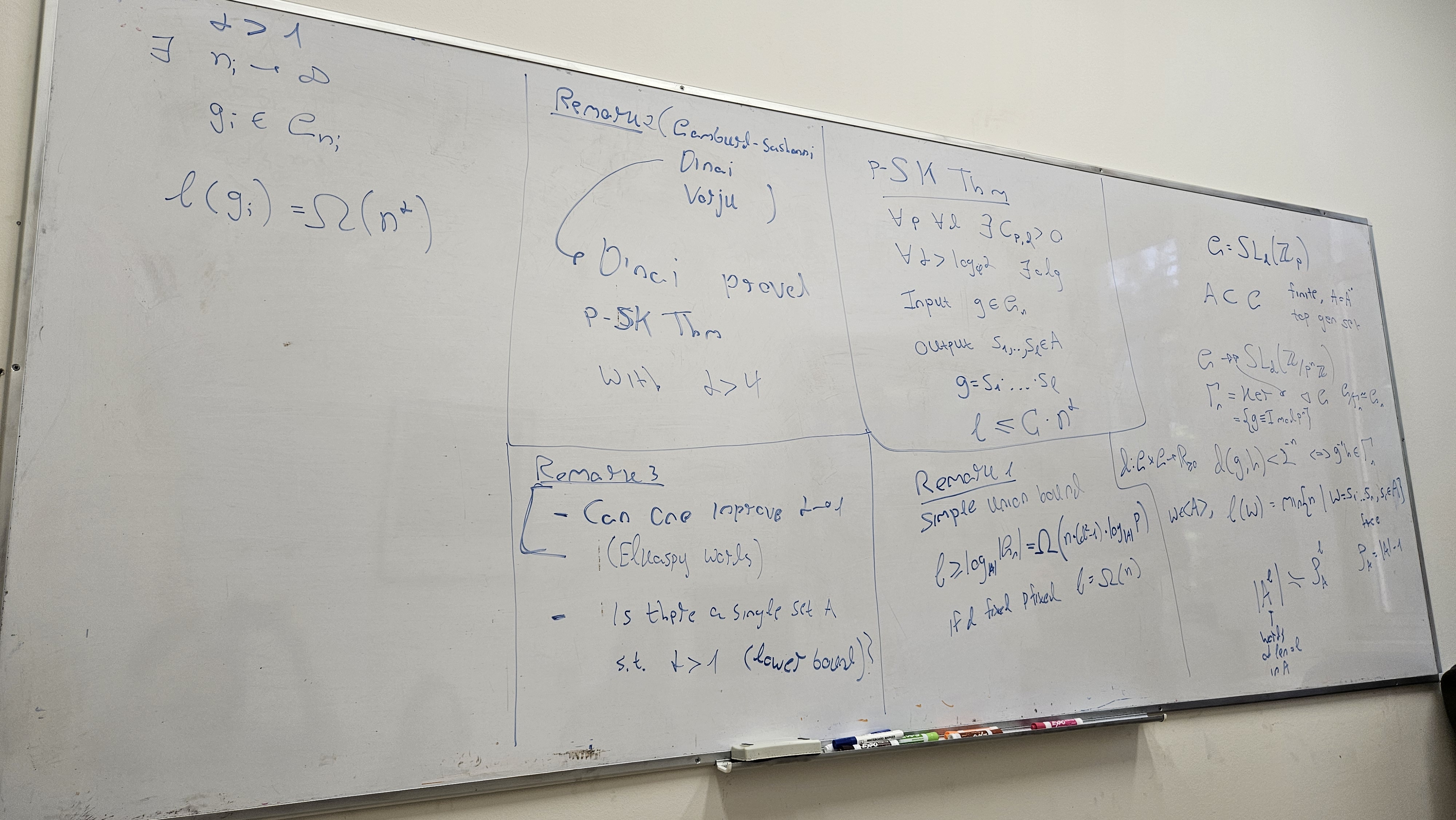
This is the statement of the theorem we will try to prove.
Theorem. Let \(G = SL_{d}(\mathbb{Z}_{p})\) be a compact matrix Lie group. Let \(A\subset G\) be a finite, topologically generating set, such that \(A = A^{-1}\). Furthermore, define the surjective map \(G\twoheadrightarrow SL_{d}(\mathbb{Z}/p^{n}\mathbb{Z})\) to have kernel \(\Gamma_{n} = \text{Ker}(G\twoheadrightarrow SL_{d}(\mathbb{Z}/p^{n}\mathbb{Z})) = \{g\in G \mid g\equiv I\pmod{p^{n}}\}\). Let there be a metric (possibly a left-invariant Finsler metric) \(d: G\times G \rightarrow \mathbb{R}_{\geq 0}\) defined such that \(d(g,h)<2^{-n}\) if and only if \(g^{-1}h \in \Gamma_{n}\), where \((g,h\in G)\). Furthermore, denote each quotient \(G_{n}\cong G/\Gamma_{n}\). Lastly, for \(\omega\in \langle A\rangle\), define the length function of a word to be \(l(\omega) = \text{min}\{n \mid \omega = s_{1}\cdots s_{n}, s_{i}\in A\}\). Then, for all \(p\) and \(d\) there exists a constant \(c_{p,d}>0\) such that for all \(\alpha > \log_{\phi}(2)\), where \(\phi\) denotes the golden ratio, there exists an algorithm such that for an arbitrary target element \(g\in G_{n}\), there exists a sequence \(s_{1},\ldots,s_{l}\in A\) such that the word \(s_{1}\cdots s_{l} = g\), and \(l\leq \mathcal{O}(n^{\alpha})\).
(22 July, 2026)
It would seem apparently difficult to justify a discussion about foreign policy when my aim on this site is to remain largely apolitical and to be a proponent of strictly mathematical interests. As a result, I aim not to specific conflicts, but rather to abstract the state of the world and its urgencies.
I have discussed ad nauseam the implications of AI in mathematics. That is not the point here, but it does play a role in some possibly unrelated meanderings. As I continue to participate in my REU in Jerusalem, Israel, I repeatedly encounter interesting qualms regarding not just complex mathematical ideas, but abstract notions of security, nationhood, neo-colonialism, and existential questions about ethnic and regional identity.
I think it's easy to look at a person as a monolith of what they do. If I were to look at myself, either from the past or the future, it would look as though I am just a collection of the things I've done and claim to do. As such, it would be easy to describe myself as a strictly mathematics-pursuing character, but this, I think, is a misinterpretation of myself. The point I'm getting at is that, almost counterintuitively, the location of this REU has led to a diversified outlook on not just mathematics, but my own interests concerning foreign policy and the pursuit of a just understanding of vital disussions that shape the modern world.
So, great. Does that mean participating in this REU has counterproductive consequences? I would argue not. In any experience, no matter how far-fetched, I think it's important to view it multi-dimensionally, as not just something that furthers one's intended pursuits, but as something that builds multiple degrees of character and intention. As I mentioned in prior posts, I think the future of mathematics shouldn't be confined strictly to academia. The nobility of doing mathematics for the sake of mathematics that G.H. Hardy discussed in A Mathematician's Apology seems outdated and crude.
Seeing many people acquire PhDs in mathematics, it seems that doing so has become less of a guarantor of acceptance and dedication to academia, and more a qualification. I think when I shift the lens to think about the difference between an achievement and a qualification, it becomes easy to see that a PhD symbolizes objective competence rather than the contribution of something novel, i.e. a qualification. Contemporary mathematics research is so dense and vast that novel contributions are rare, so most PhD projects chip away at a small chunk of a subfield. What use is that?
This is not to diminish obtaining a PhD, simpy to consider the diversification of interests. This brings me back to foreign policy. Perhaps a global mathematics education initiative to prepare new generations going into daring times would be helpful—advocating for such things at international organizations like UNESCO would be an arguably more G.H. Hardy-esque "mathematics for the sake of mathematics" pursuit.
So, counterintuitively, this REU has widened my view of mathematics-adjacent fields that aren't necessarily pure theory.
(26 July, 2026)
Why do we do mathematics? Unlike other meetings with our advisor, Professor Shai Evra, our meeting today was largely focused on some more philosophical notions of AI in mathematics (from the view of a research mathematician), motivations of a mathematician, and ultimately the question: why do we do mathematics?
Before this new era of AI, mathematicians relied on a fragile structure of mathematical rigor and formality: there are journals, conferences, seminars, colloquiums, courses, etc. and these form the foundation for which mathematics is constructed. There were some formal rules of citation and questions about simple ethics, but in this pre-AI era, researchers of mathematics were (somewhat comically) anglerfish, literally wandering blindly through all that mathematics can be. Mathematical formalism such as set-theory and ZF/ZFC became axiomatic beacons from which mathematicians floated out into the depths.
But the vast ocean has begun to light up. Small lights, faint glows, and dim luminescence. Disconnected, almost random, and—perhaps still closer to the surface of the ocean—leaving much of the depths still shrouded in darkness and uncertainty, unpenetrated by sunlight. But as the lights become brighter, it is only a matter of time before the anglerfish does not needs its light.
Now, this metaphor sounds a bit ominous. Professor Evra held that the importance of mathematical results is in its explainability: mathematics is useless when it is unexplained and does not introduce new ideas. Recently, the Jacobian conjecture was mostly resolved with a counterexample using Anthropic's most advanced LLM (Fable 5). The consensus seems to be that such a result—excluding the tools and theory used in producing such a result—would likely have received publication in Annals or something of similar caliber, marking an important contribution to the field. And yet, the counterexample produced wasn't all that novel, essentially a check and verification. So what was the real contribution to the field? Was it the fact that it was solved?
It is immediate that I agree with Professor Evra's statement. The explainability of mathematics remains its most important feature. However, if all we care about is explaining, what is the role of the anglerfish? If all that can be wandered is wandered, modulo some difficulties in terrain navigation or unpredictable currents, the anglerfish might as well put its light away and accept that it's now useless. It doesn't need to explore anymore; it need only take in the vast ocean it was missing all along. This is a fear that I expressed in a previous post, where a pessimistic future of mathematics sees mathematicians picking away at novelty in a sea of correct and incorrect results or theories. Professor Evra expressed that this would be a troubling future, but he does not see this materializing any time soon, or even at all. Perhaps it is best to remain optimistic, but Professor Evra suggested that this view would sustain: people want to be the anglerfish, not the fish wandering an already illuminated ocean searching for answers. And yet, I think this is a skewed view to take.
Current mathematicians, and even current humans, will always have a bias toward the present. Society is changing. All it takes to change the entire profession of a mathematics researcher is a change of perspective: from "this result must be mine and only mine" to "it doesn't matter if this result is mine, as long as it makes sense to me and is explainable to my colleagues." In a way, modern pre-AI mathematics demands selfish tolerance. Preserving our intellectual property is fundamental to our own preservation in society, so the normalization of "results" over "why and how we got these results" seems like the critical point. For now, we see simple computations as "trivial," but at what point will simple computations become simple lemmas, then simple propositions, and so on? If this does happen, we won't know it until it has slowly infiltrated the norm.
To the anglerfish (which is almost entirely blind), the true extent of the depths of the ocean is not realized until it is fully illuminated. Its light will slowly dim, and soon it will be gone.
So what is there to make of this? Is this post-AI era of mathematics truly just anglerfish wandering the depths of an ocean that is slowly becoming more and more illuminated, or will the lights always be too dim to illuminate the entirety of the depths?
So despite—or because of—all of this, why do we do mathematics? It's easy to come up with both an insightful and pathetic answer to this question. Of course, the pathetic answer doesn't get very far, but I think it's meaningful to evaluate the insightful answer more carefully. Professor Evra shared that Simon Singh's book Fermat's Last Theorem, documenting the 358 year-long search for a solution to one of the most easily-stated yet most novel results in recent human history, was when he became truly interested; he wanted to understand the proof, and to this day, though he has specialized in other fields, it remains on his to-do list.
I could point to particular books or things that led to my interest in mathematics, like Donald Knuth's Surreal Numbers or John Conway's On Numbers and Games. Maybe it's best to take comfort in what we believe to be true about ourselves if it is what motivates us.
(1 August, 2026)
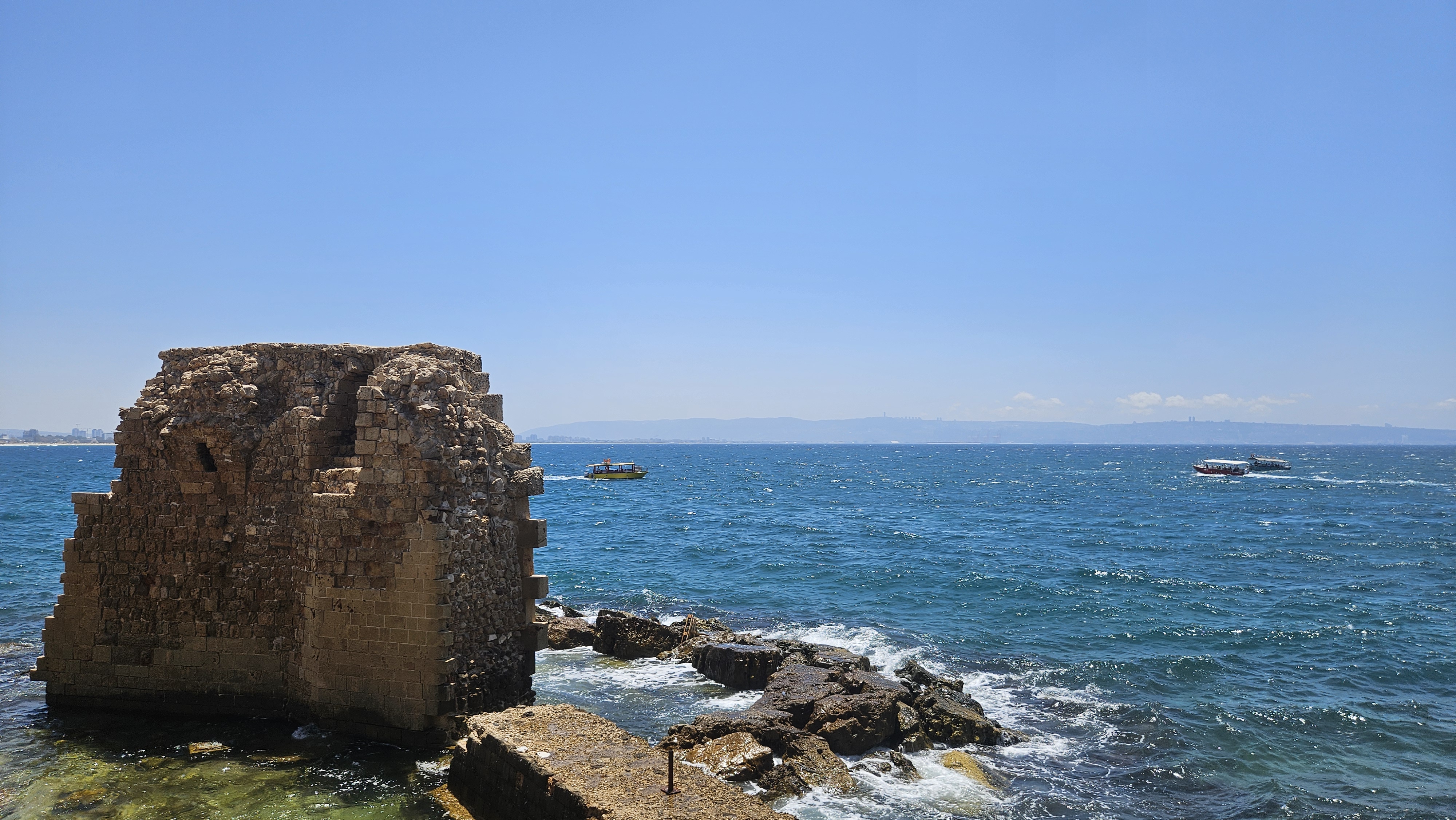
The REU is coming to a close (7 August). I've had a lot of fun documenting some of my endeavours, struggles understanding things, and fun experiences with regard to travel and pseudo-photography. I imagine this will be my last formal update, with the remaining updates being related to the deliverable of this project (which I will discuss briefly later). I hope this post paints a good picture of the positives and negatives of a math REU—I have tried to be objective and apolitical, and for anyone who endeavours to read the entirety of this document, I commend your patience. This document will evidently serve as a useful resource for me (and hopefully others) in the future.
We have begun writing our final paper pending adjustments to purpose. The paper will be titled something adjacent to "Improved Poly-Log Diameter Bounds for \(SL_{2}(\mathbb{Z}_{p})\) via Higher Commutators." Aside from updates regarding the paper(s), I will likely include some concluding remarks and possibly anything else notable. But for now, the program has come to a close.
Concluding remarks
I will attempt to keep these concluding remarks fairly succinct. Looking back at everything this REU has offered me, it's tempting to think that it creates a conclusive perspective about how I should think about mathematics, and more importantly, whether it is something I should want to pursue. If anything, this REU has complicated the question entirely. This post has spoken ad nauseam about the impact of AI on every aspect of our lives, from its less noticeable aspects to its field-revolutionizing aspects, particularly in academia. In the 3 months I have been gone, I have watched AI become the pinnacle of human endeavour, acknowledging that this is just the beginning. In the 3 months I have been gone, AI has raised question after question about the novelty of human thought. And still, there is little possibility to accurately predict this future.
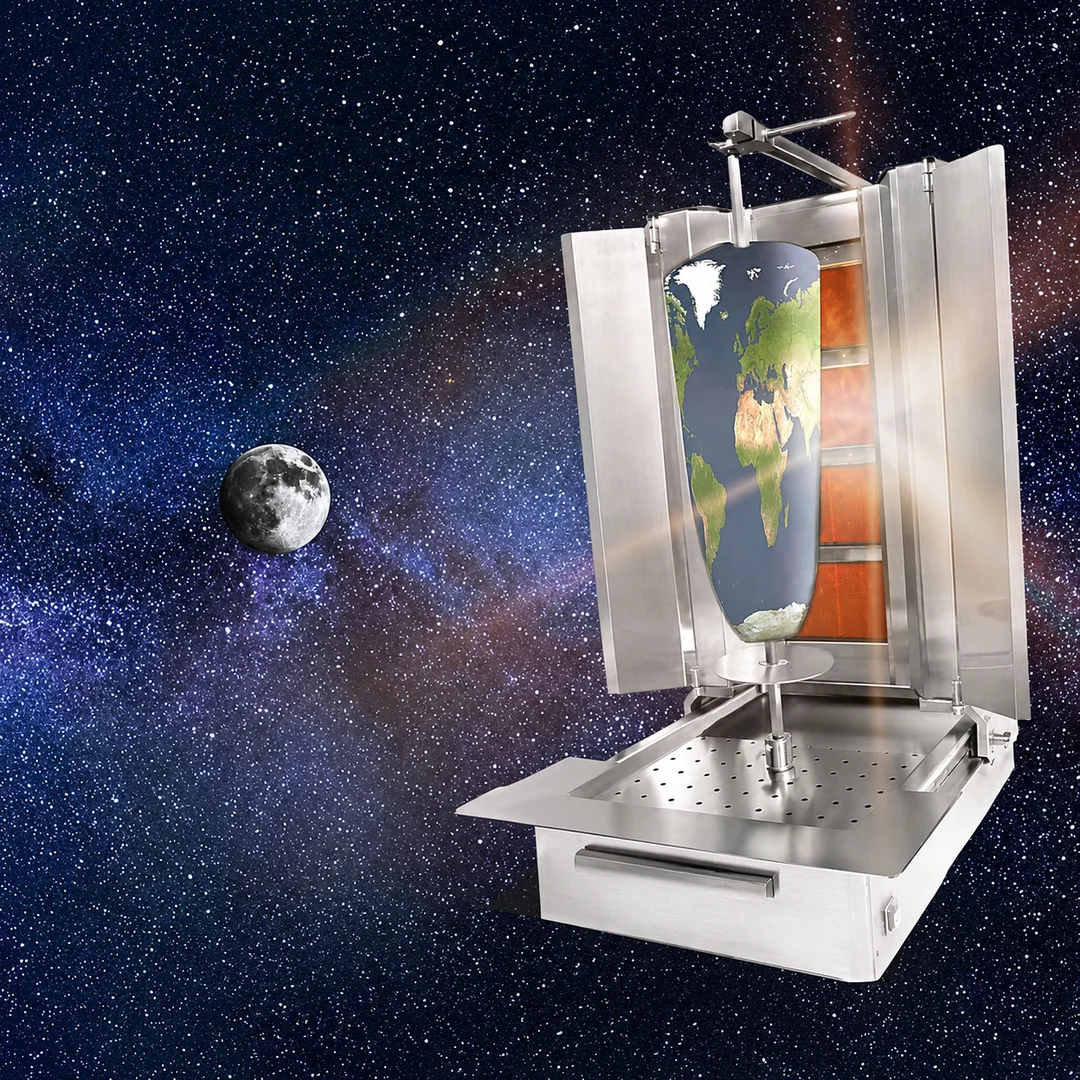
So how can I maintain my own novelty in mathematics while I watch it crumble around me? AI optimists and pessimists hold very different perspectives, but in the field of mathematics, there seems to be a trend toward ensuring humans continue to play an integral role. Some have illuminating perspectives that will theoretically limit AI usage in mathematical research, calling for harsh treatments. Really, if anything, I believe humans are here to stay, no matter what.
In a final conversation with Professor Evra before departing, we asked another question that I believe the sensationalization of the alleged trivilization of mathematics fails to recognize. While mathematics can be constructed axiomatically from logical structures and may (soon) be verified entirely in LEAN, unlike other fields, the beauty of mathematics is that many parts of it (particularly pure mathematics) are not applicable to modern applications and effectively do not matter. And even so, innovations in mathematics, applied or pure, find themselves in unlikely applications, whether through emerging technologies or political shifts. In this way, the only assumption society needs to make is that mathematics development is still important, despite loud sensationalized claims of it being trivial. Unlike other fields that have immediate impacts, a good question is: why the rush? Certainly, AI has solved and will solve more problems in mathematics, and there is nothing we can do to stop it, nor should we. But many mathematicians agree that mathematical novelty isn't in reaching results faster, rather it is in maintaining the community that makes such results important, understandable, and genuinely interesting. So, is it really a bad thing if AI develops exponentially, yet fundamental mathematical progress, modulo some smaller results that weren't too interesting anyway, is linear?
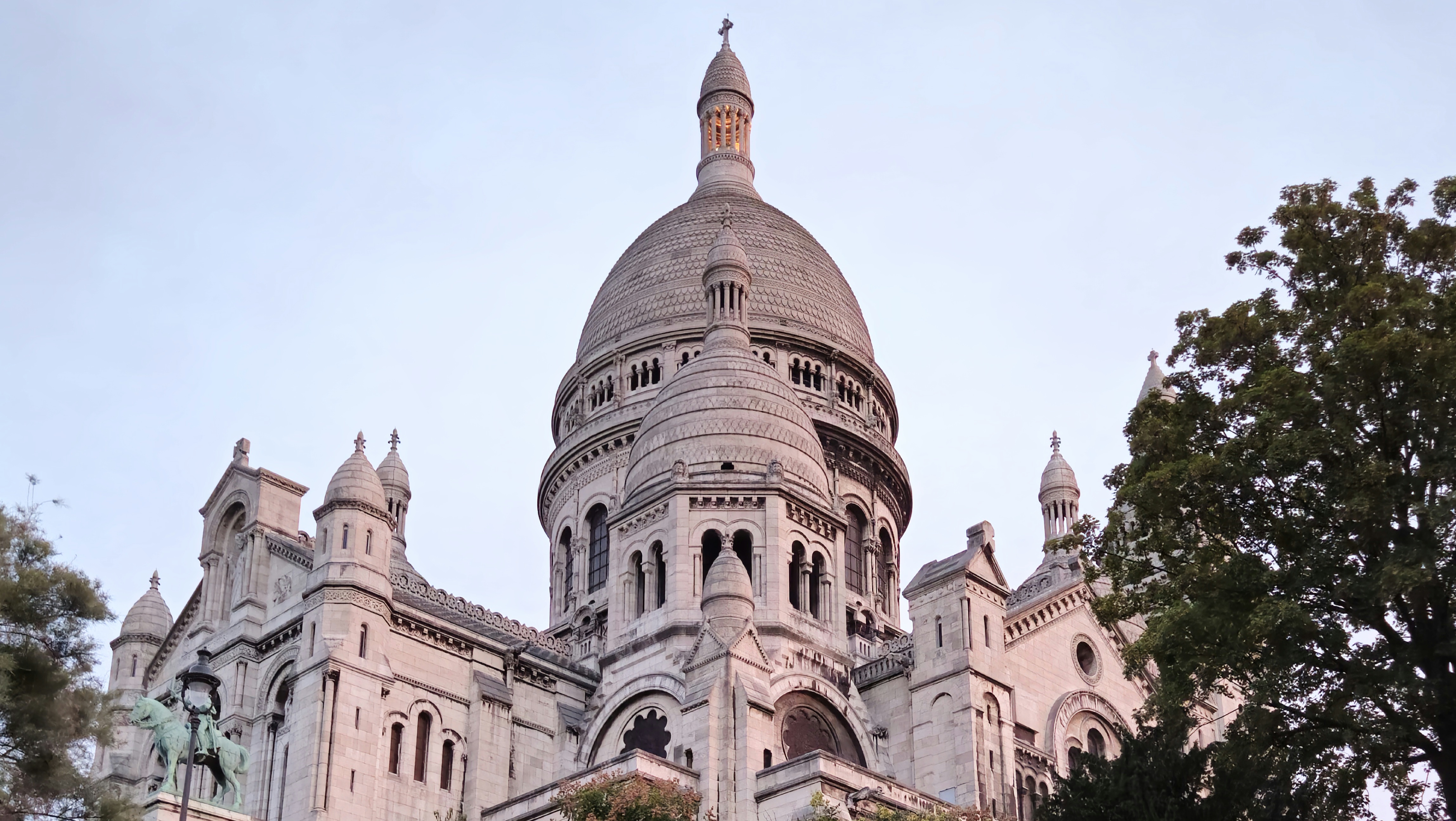
There is no reason to rush mathematical discovery. This returns to my post from earlier, where unless we can actually extract meaning from everything we or AI can achieve, it is effectively useless. Meaning comes in many forms, but I think mathematical meaning is fundamentally intertwined with the community built around it, and this community extends into areas like education, mentorship, discovery, research, inspiration, and so much more. Perhaps for a little while AI will solve countless problems with pristine LEAN-verifiable accuracy, but it is only a matter of time before mathematicians must strive to shed their ignorance and selfishness to actually care about why we do mathematics in the first place.
Beyond revelations that this REU has given me with regard to AI, I think this REU has given me an even broader worldview, and for that I am grateful. Many things I disagreed with, but a mutual understanding has led me to become more critical of my own biases. Thank you to the Einstein Institute of Mathematics at HUJI for a revelating and stimulating experience, to Professor Evra for his excellent mentorship, and to the people who made this program bearable.